

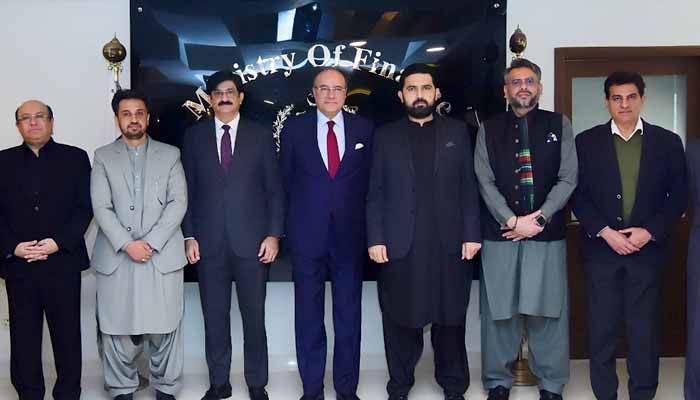
The 11th National Finance Commission (NFC) session in Islamabad achieved clear momentum on Thursday as the federal and provincial leadership agreed to create six to seven working groups to advance fiscal reforms. The NFC meeting focused on improving federal–provincial financial coordination, addressing integration of former FATA districts, and exploring revisions to vertical and horizontal resource distribution. These developments gained high national attention as provinces and the Centre showed rare consensus on transparency and dialogue.
The NFC session was chaired by Finance Minister Muhammad Aurangzeb and attended by the finance representatives of Sindh, KP, Punjab, and Balochistan. KP Adviser on Finance, Muzzammil Aslam, confirmed that the NFC will form separate working groups under an umbrella oversight body. One group will specifically address fiscal incorporation of merged districts from the former FATA region, ensuring they enter the federal fiscal framework efficiently.
Both Murad Ali Shah and Muzzammil Aslam described the meeting as constructive, highlighting that views were heard without pressure. No proposal was tabled regarding a reduction in provincial shares, countering speculation circulating in political and media circles.
The NFC’s next sitting is expected on January 8 or 15.
Aurangzeb Calls Meeting a Constitutional Milestone Under Article 150
Finance Minister Aurangzeb underscored that the inaugural session fulfilled a constitutional responsibility. He stressed that Prime Minister Shehbaz Sharif personally pushed for the meeting to take place without delay. He recalled that earlier sessions were postponed due to severe floods in Sindh, KP and Punjab.
Aurangzeb reiterated that the federal government came to the table with an open mind, ready to listen. He praised the provinces for cooperation on mandatory surpluses and IMF conditions. He emphasized that unity against extraordinary threats, such as India-related security concerns and historic floods, demonstrated the federation’s strength.
Planning Ministry Paper Proposes Revision to NFC Allocations
Ahsan Iqbal’s Planning Ministry shared a working paper titled “Revisiting the NFC Award,” suggesting recalibration of vertical and horizontal resource distribution.
Proposed Vertical Allocation Scenarios
-
Scenario 1: Deduct 2.5 percent upfront for national priorities like counter-terror operations, water security and grants to AJK & GB. Remaining funds are divided: provinces 57.5 percent and Centre 42.5 percent.
-
Scenario 2: BISP and HEC spending deducted upfront before distribution. Provinces receive 57.5 percent; Centre gets 42.5 percent. By FY2030, federal resources rise 11–12 percent over baseline.
The aim is to ease federal fiscal strain while protecting provincial autonomy.
Horizontal Distribution: Reducing Population Weight
The paper highlighted structural imbalance, noting population weighs 82 percent under current rules. Three options seek a fairer model by elevating indicators such as revenue generation, ecological contribution and fertility reduction.
Impact Under Three Options
-
Punjab: Share falls from 51.74% to between 47.26% and 41.89%.
-
Sindh: Remains around 25%.
-
KP: Rises from 14.62% to between 17.12% and 15.67%.
-
Balochistan: Climbs from 9.09% to between 9.75% and 12.02%.
-
ICT: Jumps from 0.83% up to 5.33% under scenario three.
These proposals recognize provincial fiscal effort, geographic realities and environmental stewardship.
Structural Fiscal Challenges Need Reform, Not Status Quo
The Planning Ministry warned that Pakistan’s federal fiscal deficit remained between 5 and 8.4 percent for a decade, driven by structural imbalance and high debt servicing. Despite receiving 57.5 percent of divisible pool transfers, provincial revenues remain stagnant near 1 percent of GDP.
Experts view the recalibrated NFC model as essential for long-term sustainability, improved provincial tax mobilisation, and stronger federal capacity to meet national obligations.