

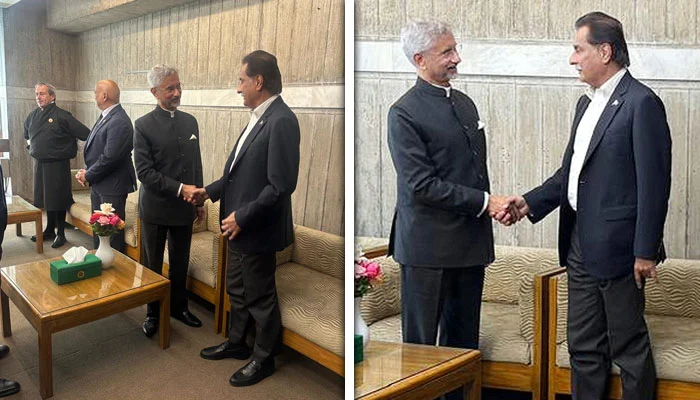
In a region long accustomed to sharp rhetoric and diplomatic deadlock, even the smallest gestures can carry disproportionate weight. The brief and informal interaction between Pakistan’s Speaker of the National Assembly, Sardar Ayaz Sadiq, and India’s External Affairs Minister Dr S. Jaishankar in Dhaka may not alter the trajectory of Pak-India relations overnight, but it is nonetheless noteworthy.
The encounter occurred on the sidelines of the funeral of former Bangladeshi prime minister Khaleda Zia, where both leaders were present to pay their respects. According to reports, Dr Jaishankar walked over to Ayaz Sadiq’s seat, exchanged a handshake, and shared a few cordial words. No statements followed, no official agenda was attached, and no diplomatic breakthrough was announced — yet the symbolism was hard to ignore.
This moment marks the first high-level interaction between Pakistani and Indian officials since the armed conflict in May, after which bilateral relations plunged to their lowest point in years. Political dialogue was suspended, diplomatic engagement halted, and even symbolic gestures — such as handshakes in sports — became casualties of the hostility.
Against this backdrop, the Dhaka interaction stands out precisely because of its informality. It neither violated stated positions nor compromised official policies. Instead, it served as a reminder that diplomacy often begins not with negotiations, but with acknowledgment.
The funeral itself drew thousands, including Bangladesh’s Chief Adviser Muhammad Yunus and senior officials from across South Asia, underlining Dhaka’s role as a neutral regional space where political adversaries can momentarily coexist without confrontation.
Pakistan’s representation by Ayaz Sadiq reinforced Islamabad’s respect for regional relationships, while India’s presence reflected continuity in engagement with Bangladesh. That the two rivals crossed paths — and chose civility over avoidance — may suggest that total disengagement is neither sustainable nor desirable.
History offers ample precedent: dialogue between Pakistan and India has often resumed quietly, long before public narratives catch up. The handshake in Dhaka does not signal détente, but it does suggest that even amid entrenched hostility, diplomatic doors are rarely sealed completely.
In an era where silence has replaced dialogue, even a brief exchange of pleasantries can be interpreted as a faint — but meaningful — diplomatic signal.