


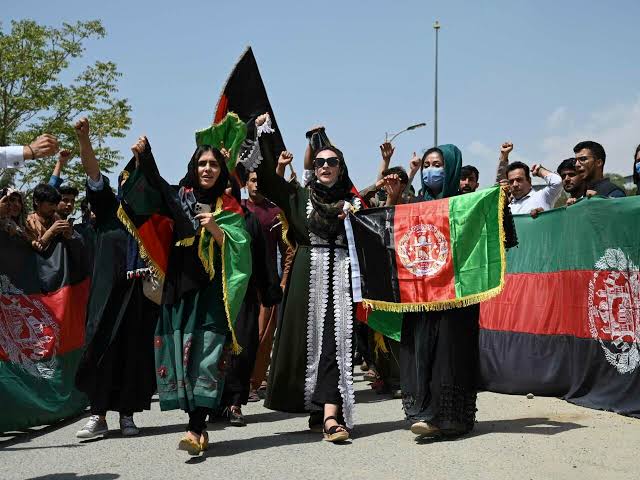
Anti-Taliban protests worldwide broke out across 28 cities as demonstrators marked five years since the group seized control of Afghanistan, with many calling on foreign governments to reject normalisation with the Taliban and formally acknowledge gender apartheid in the country.
Demonstrations were reported in a wide range of locations, including Bonn, Geneva, Amsterdam, Munich, Stuttgart, Hamburg, Islamabad, Berlin, Kiel, Frankfurt, Helsinki, Zurich, Oslo, Cologne, Vienna, The Hague, Stockholm, Madrid, Barcelona, Bilbao, Toronto, New Westminster, Reston, Düsseldorf, Tehran, Paris, London, and Washington.
In several of these cities, Afghan nationals marched through the streets chanting against Taliban rule, while other communities opted for meetings, advocacy sessions, protest encampments, and even hunger strikes. Across the board, the demonstrations centered heavily on the treatment of Afghan women and girls, along with firm opposition to any diplomatic warming toward the Taliban government.
Europe Sees Widespread Demonstrations
In Bonn, the Campaign Against Gender Apartheid in Afghanistan organized a rally outside the United Nations office, closing the event with a formal resolution. The statement urged the UN and global community to officially recognize and criminalize gender apartheid, halt any moves toward legitimizing the Taliban, and ensure Afghan women, survivors, and civil society voices are included in international discussions. A separate group of Afghans also protested outside the same UN office that day.
Geneva hosted a gathering outside the UN office as well, where organizers said their goal was to keep Afghan women’s stories visible internationally and draw attention to ongoing human rights violations, while affirming women’s rights to freedom, equality, and dignity.
Berlin’s protest activities stretched across multiple days, featuring a demonstration tent and a voluntary hunger strike that wrapped up on August 15 with a closing rally near the Brandenburg Gate. Organizers framed the effort as a stand for human dignity and equal rights in Afghanistan.
In Munich, a mixed crowd of Afghan activists, scholars, human rights advocates, politicians, and artists gathered at Bellevue di Monaco. Women joining remotely from Afghanistan and Pakistan shared firsthand accounts of the restrictions they currently face. Discussions ranged from education and the economy to migration, asylum policy, and how Germany and the EU should approach Afghanistan going forward. The event closed with a resolution declaring education, employment, freedom, and dignity as basic rights, while urging that any political dealings with the Taliban factor in the country’s human rights record.
Kiel held an event called “Voice of the Unseen,” followed by cultural programming, while the Schleswig-Holstein Refugee Council pushed for a halt to deportations back to Afghanistan and stronger protections for at-risk Afghans.
Amsterdam saw several organizations stage demonstrations in Dam Square, with protesters urging the Netherlands and the broader EU to avoid legitimizing the Taliban and to keep Afghan women’s rights at the forefront of policy discussions.
Meanwhile, Spain hosted parallel events in Madrid, Barcelona, and Bilbao as part of a coordinated international campaign timed to August 15. In Madrid specifically, Afghan women, refugees, and feminist organizations rallied in Puerta del Sol, calling on the global community to act more decisively on behalf of Afghan women’s rights.
North America and Asia Join the Movement
In Toronto, demonstrators gathered at Queen’s Park to highlight women’s right to education and work, urging the Canadian government to withhold recognition of the Taliban. The city’s Afghan community also released a resolution demanding an end to gender apartheid, opposition to normalized relations with the Taliban, protections for women and girls, media freedom, refugee support, and independent probes into rights abuses.
Islamabad, one of the closer geographic points to Afghanistan, saw a joint demonstration by multiple Afghan women’s movements and human rights organizations. Attendees chanted against Taliban rule and stressed that the fight for women’s education, employment, and broader freedoms would continue.
Hamburg’s demonstration brought together Afghan migrants and civil society members who condemned Taliban governance and criticized Germany’s current policy approach, including the deportation of Afghan refugees. A companion conference, “Five Years of Taliban Rule: The Current Situation, Germany’s Afghanistan Policy and the Resistance of Hamburg’s Afghan Community,” was held at Hamburg City Hall to examine the political, social, and humanitarian fallout of Taliban rule alongside Germany’s response.
In Frankfurt, activists labeled August 15 a dark chapter in Afghan history, chanting phrases like “No to the Taliban” and “Education, work, freedom,” while calling on the international community to prioritize Afghan civil liberties and human rights.
Additional Global Events
Oslo hosted multiple gatherings, including a march from the Afghan embassy to the Norwegian parliament in support of Afghan women, alongside a separate session titled “From Advocacy to Accountability,” organized by the Dialogue Hub for Common Ground and the Women’s Justice Movement, focused on justice and long-term advocacy strategies.
New Westminster, Canada, held “Fresh Wound: From Remembrance to Action,” combining expert talks, a panel discussion, protest music, and theater to explore themes of gender apartheid and cultural erasure.
Cologne’s “Five Years of Taliban Rule” gathering at Heumarkt square brought together groups such as Afghanistan Is Not Safe Cologne and Bonn, Anar Academy, Amnesty International Cologne, and Mosaik Köln-Mülheim in solidarity with Afghan women.
In Reston, Virginia, the event “Afghanistan, Five Years After the Fall” ran from 3 to 6 pm at the North County Governmental Center, dedicated to honoring victims and amplifying the experiences of Afghan women, refugees, and separated families.
Additional demonstrations tied to the anniversary also took place in Stuttgart, Helsinki, Zurich, Vienna, The Hague, Stockholm, and Düsseldorf.
Victory Day for the Taliban, Black Day for Its Critics
On August 15, 2021, the Taliban marched into Kabul as US and NATO troops withdrew and the Afghan republic collapsed. Then-president Mohammad Ashraf Ghani fled the country that same day, allowing the Taliban to take the capital largely without resistance.
Since then, the group has commemorated the date as “Victory Day” or “Day of Conquest,” framing it as the end of foreign occupation, complete with annual ceremonies and official speeches. Critics of the regime, however, including civil society activists and everyday Afghan citizens, refer to the same date as a “black day,” organizing protests across the globe in response.
Five years on, the Taliban government still lacks formal recognition from every country in the world except Russia. During this period, the group has enacted sweeping restrictions on Afghan life, with women and girls facing the harshest limitations on education, employment, and public participation.