


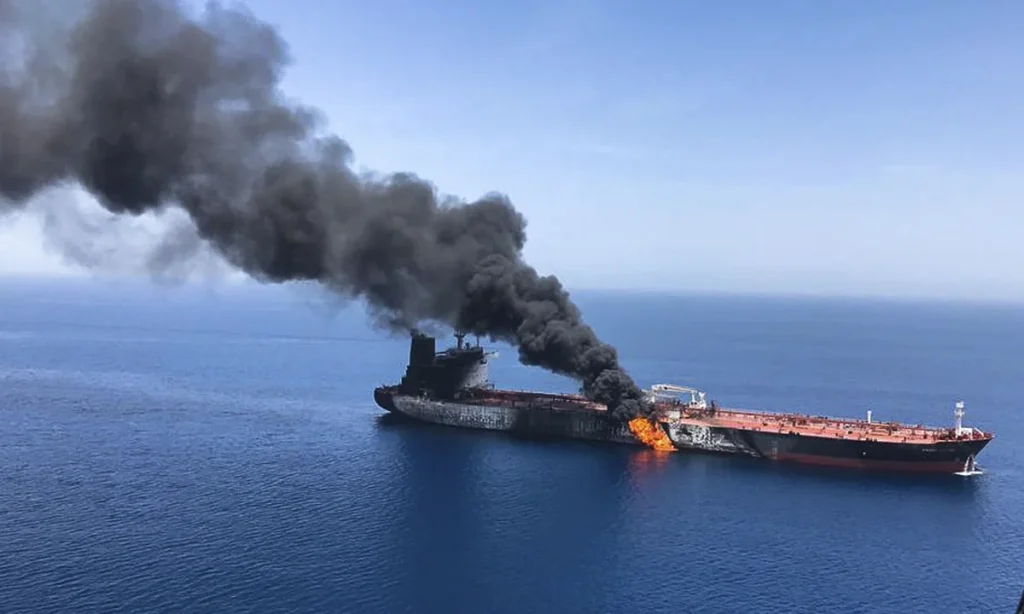
Attacks on oil tankers in Gulf waters intensified on Wednesday after explosive-laden boats believed to be linked to Iran struck two fuel tankers near Iraqi waters. The explosions set both vessels on fire and left at least one crew member dead, according to port officials and maritime security companies.
The latest attacks on oil tankers in Gulf waters signal a dangerous escalation in the ongoing confrontation between Iran and US-Israeli forces. Since the conflict began, at least 16 ships have been hit in different incidents across the region.
The vessels targeted during the late-night assault were the Marshall Islands-flagged Safesea Vishnu and the Malta-flagged Zefyros. Both ships had loaded fuel cargo in Iraq before the attacks occurred in a ship-to-ship transfer area within Iraqi territorial waters.
Officials said rescue teams moved quickly to save crew members trapped on the burning ships. An Iraqi port boat pulled 25 sailors from the water, while emergency teams continued searching for missing seafarers. Authorities later confirmed that the body of a foreign crew member had been recovered.
The attacks on oil tankers in Gulf waters have forced Iraq to halt operations at its oil ports. Officials said commercial ports remain open, but oil exports have stopped until the situation becomes safe.
Tensions in the region have already disrupted shipping routes through the Strait of Hormuz, a critical passage that carries nearly one-fifth of the world’s oil supply. Since the conflict began in late February, many shipping companies have paused movement through the narrow waterway due to security risks. The disruption has pushed global oil prices to levels not seen since 2022.
Iran’s Revolutionary Guards have repeatedly warned that continued military pressure on Iran could lead to a full blockade of oil shipments in the region. They said they would not allow even “one litre of oil” to reach the United States, Israel or their allies if attacks on Iran continued.
Meanwhile, former US president Donald Trump warned that Washington could respond with stronger military action if Iran interferes with global oil routes. He also claimed Iran’s naval strength had been severely weakened.
The violence on Wednesday did not stop with the tanker fires. Earlier the same day, projectiles struck the Thai-flagged bulk carrier Mayuree Naree while it passed through the Strait of Hormuz. The attack sparked a fire in the engine room and left three crew members missing, believed to be trapped inside. The rest of the crew were safely evacuated to Oman.
Images released by naval authorities showed thick smoke rising from the damaged ship as rescue efforts continued.
Additional vessels also reported damage across the Gulf. The Japanese-owned container ship ONE Majesty suffered minor hull damage after an unidentified projectile hit the vessel while it was anchored near Ras Al Khaimah in the United Arab Emirates. The crew remained safe and the ship continued operating.
Another bulk carrier, the Marshall Islands-flagged Star Gwyneth, was struck by a projectile northwest of Dubai. Maritime risk analysts said the blast damaged part of the hull but caused no injuries.
Security officials reported yet another incident early Thursday when a container ship north of Jebel Ali caught fire after being hit by a projectile. The crew managed to control the situation and no casualties were reported.
These repeated attacks on oil tankers in Gulf waters have raised alarm across the global shipping industry. Many operators now fear that the Strait of Hormuz could become a direct battlefield if tensions continue to rise.
Shipping companies and energy markets are closely watching developments in the Gulf. Any prolonged disruption in the area could threaten international oil supply and push energy prices even higher worldwide.