


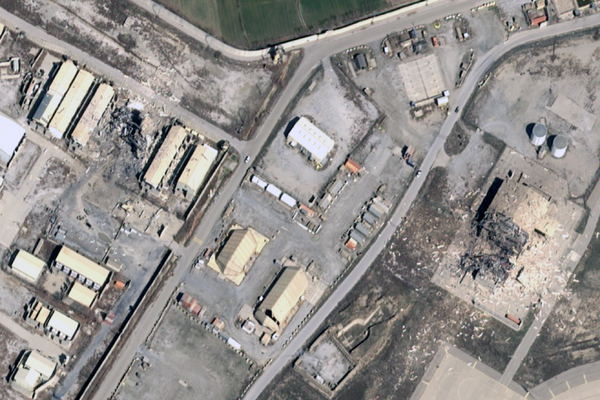
The Bagram Airbase airstrike has caused significant military damage, according to Afghanistan’s Ministry of Defense, which released a detailed report confirming losses at the former US military base. The strike marks one of the most serious escalations in the ongoing Pakistan-Afghanistan tensions.
Officials in Kabul said the Bagram Airbase airstrike resulted in heavy destruction inside the facility. Several key military assets were destroyed, including Black Hawk helicopters, a Hercules cargo aircraft, a Tucano aircraft, and multiple armored vehicles. The attack reportedly took place around 5 a.m. on Sunday, when Pakistani fighter jets entered Afghan airspace and targeted the base.
Initial statements from Afghan authorities claimed that air defense systems had intercepted the attack. However, satellite imagery and the official damage assessment later confirmed explosions inside the compound and structural destruction across parts of the base. The confirmed Bagram Airbase airstrike damage has raised concerns about Afghanistan’s remaining air capabilities.
The base, located north of Kabul, served as a major US military hub before American forces withdrew. After the withdrawal, Taliban authorities took control of the facility. Security analysts say the Bagram Airbase airstrike has dealt a serious blow to Afghanistan’s limited air power and logistics capacity.
Pakistan has defended the Bagram Airbase airstrike as part of a broader campaign against TTP safe havens and armed groups operating from Afghan territory. Pakistani officials argue that cross-border attacks forced them to act. They insist the operation targets militant infrastructure, not civilians.
Taliban authorities strongly rejected that claim. They described the Bagram Airbase airstrike as aggression and announced plans for retaliation. The strike follows recent border clashes that both sides have described as open confrontation.
Fighting along the frontier has intensified over the past week. Pakistan has hit multiple locations inside Afghanistan, citing Operation Ghazab ul Haq as part of its security strategy. Afghan officials continue to deny providing safe haven to militant groups.
The international community has called for restraint. Diplomatic voices warn that further cross-border military escalation could destabilize the region. Despite these appeals, neither side has signaled a pause.
The Bagram Airbase airstrike now stands as a turning point in the latest phase of the Pakistan Taliban conflict. Whether it leads to deeper escalation or forces renewed dialogue remains uncertain.