


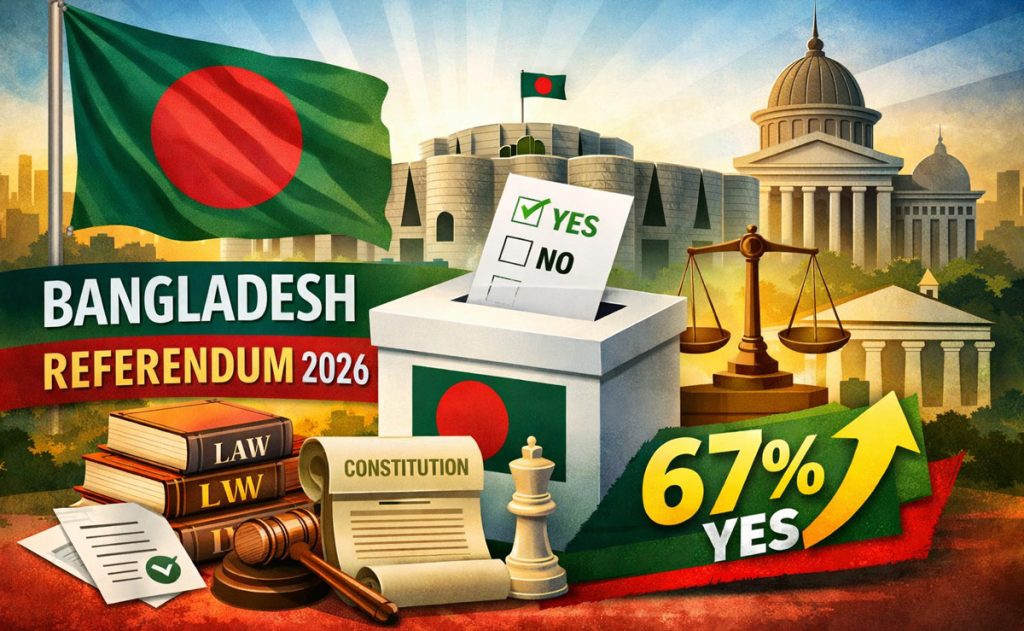
DHAKA: In a historic development for Bangladesh, preliminary results of the Bangladesh Referendum 2026 indicate that 67% of voters have supported sweeping constitutional reforms proposed under a Gen Z-led movement. This referendum, held alongside the country’s 13th national parliamentary elections, marks a significant step in reshaping the political and constitutional landscape after the end of Sheikh Hasina’s two-decade-long rule.
The elections themselves were a culmination of 18 months of intense student-led activism. This movement, originating in July 2024, successfully challenged long-standing political structures and called for democratic reforms, transparency, and accountability in governance. The referendum was a mechanism to give legal form to these demands, allowing citizens to voice their opinion on a broad range of constitutional amendments.
Background: The Rise of the Student-Led Movement
Bangladesh has experienced decades of political centralization under the Awami League, with Sheikh Hasina’s government holding power for over 20 years. Despite periods of economic growth, critics argue that political power became concentrated in the hands of a few, often stifling opposition and limiting institutional independence.
The July 2024 movement, primarily driven by students and young professionals, highlighted systemic issues such as corruption, lack of transparency, and limited citizen participation in policy making. It quickly gained momentum nationwide, with demands for institutional reforms, stronger democratic checks and balances, and fair governance.
The student-led activism ultimately led to the fall of Sheikh Hasina’s government, setting the stage for a transformative election cycle. Citizens, particularly the youth, viewed the 2026 parliamentary elections and accompanying referendum as a chance to reshape the nation’s future.
The Referendum Process
The Bangladesh Referendum 2026 asked voters to respond “Yes” or “No” to a series of proposed constitutional reforms laid out in the July National Charter. The charter itself is a comprehensive document designed to strengthen democracy, prevent the over-concentration of power, and institutionalize good governance practices.
The referendum focused on four major constitutional amendments and approximately 30 broader reforms. These include:
- Creation of New Constitutional Institutions: Ensuring independent oversight and accountability mechanisms to reduce misuse of power.
- Bicameral Parliament: Transforming the current single-chamber parliament into a two-house system, including a Senate, to provide better legislative scrutiny.
- Approval Requirement for Constitutional Amendments: No constitutional changes can be made without the consent of the upper house (Senate), enhancing checks and balances.
- Prime Ministerial Term Limits: Limiting the tenure of the prime minister to prevent indefinite rule.
- Expansion of Presidential Powers: Balancing executive authority to avoid power concentration in one office.
The ballot papers were simple and user-friendly. Voters had to mark either “Yes” or “No,” ensuring clarity in capturing public opinion.
July National Charter: Vision and Objectives
The July National Charter is rooted in the demands of the 2024 public movement. Drafted by the Muhammad Yunus-led National Consensus Commission, the charter incorporated inputs from major political parties, though the Awami League chose not to participate.
The charter emphasizes:
- Strengthening democratic institutions
- Ensuring social justice and equality
- Promoting transparency in governance
- Preventing the concentration of power in any single individual or institution
Analysts argue that the charter represents a blueprint for long-term political stability. By giving citizens a direct voice in approving constitutional changes, the referendum enhances public ownership of governance reforms.
Election Results and Voter Response
Unofficial results indicate that 67% of voters approved the reforms, while 33% opposed them. The strong majority reflects widespread public support for change and a desire to move away from centralized governance.
Political analysts note that this outcome signals a generational shift. Young voters, particularly those active in the 2024 movement, played a crucial role in mobilizing support for the referendum. Citizens seem determined to ensure that future governments adhere to principles of accountability, transparency, and participatory democracy.
Implications for Bangladesh’s Political Landscape
The approval of these reforms could reshape Bangladesh’s political and institutional structure in several ways:
- Strengthened Checks and Balances: With new institutions and a bicameral parliament, legislative oversight will improve, reducing the risk of unchecked executive authority.
- Democratic Consolidation: Term limits and mandatory upper house approval for constitutional amendments aim to prevent prolonged political dominance by any single party or leader.
- Institutional Stability: Independent oversight bodies and enhanced presidential powers can help stabilize the political environment, especially during periods of transition.
- Youth Engagement: The referendum demonstrates the growing influence of younger generations in shaping national policy.
Experts suggest that successful implementation of these reforms could turn Bangladesh into a model for participatory democracy in South Asia.
Reactions from Political Parties
While major parties contributed to drafting the charter, the Awami League chose to abstain. Analysts believe this reflects internal disagreements over the proposed reforms.
Supporters of the referendum argue that the “Yes” vote is a clear mandate for change. Opposition leaders have pledged to respect the results but emphasize the need for ongoing dialogue and consensus-building to implement reforms effectively.
Historical Context: End of Sheikh Hasina’s Rule
The 2026 parliamentary elections and referendum are significant in the context of Bangladesh’s recent history. Sheikh Hasina’s two-decade rule was marked by both development and political centralization. Critics often highlighted issues such as limited parliamentary oversight, media restrictions, and marginalization of dissenting voices.
The student-led 2024 movement acted as a catalyst for democratic renewal, culminating in a new parliamentary mandate and constitutional referendum. Analysts suggest that this period could define the next phase of Bangladesh’s democratic evolution.
What’s Next: Implementation and Oversight
Following the referendum, the government and relevant authorities will need to:
- Legally incorporate the approved amendments
- Establish new constitutional institutions
- Transition parliament to a bicameral system
- Ensure proper checks and balances before implementing term limits and presidential powers
Observers note that successful implementation will require cooperation between political parties, civil society, and citizen stakeholders. Monitoring mechanisms will be key to ensuring that the reforms achieve their intended objectives.
The Bangladesh Referendum 2026 represents a landmark moment in the nation’s history. With 67% of voters approving Gen Z-led reforms, Bangladesh appears ready to embrace stronger democratic institutions, enhanced governance, and greater citizen participation.
This historic vote reflects a desire to move beyond centralized political power and toward a more accountable, transparent, and inclusive system. While challenges remain, the referendum sets a new benchmark for democratic engagement in South Asia.
The eyes of the world are now on Dhaka as Bangladesh begins implementing these reforms, potentially setting an example for other nations striving for democratic renewal and institutional integrity.