


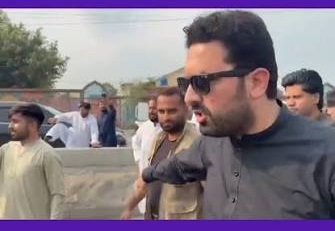
The controversy surrounding KP Chief Minister Sohail Afridi’s alleged arrest has produced plenty of political noise, but it has also exposed a far more serious question that the KP government would perhaps prefer to avoid: why can the chief minister move around freely in Lahore, while questions continue to surround his ability to travel freely in the province he governs?
Punjab Information Minister Azma Bokhari has rejected the claim that Afridi was arrested, saying that he voluntarily sat in a police vehicle and turned the episode into a political spectacle. According to her, the incident was not an arrest but an attempt to attract public and media attention.
Whether one accepts Bokhari’s account or the version promoted by PTI, the incident has failed to establish a convincing case of abduction. Instead, it has shifted attention toward a much bigger issue, the deteriorating law and order environment in Khyber Pakhtunkhwa.
The irony is difficult to miss.
Sohail Afridi is currently in Lahore, the largest city and political centre of Punjab, where he has been able to move around without the kind of restrictions that have become associated with his movements in KP. The same chief minister, however, faces an entirely different security reality when it comes to his own province.
That raises a straightforward question: If the chief minister of KP can walk around the streets of Lahore, why does he not have the same confidence and freedom of movement in Khyber Pakhtunkhwa?
This is not merely a political talking point. It goes to the heart of governance.
A chief minister is supposed to represent the authority of the provincial government. If the province’s own chief executive cannot freely move around without extraordinary security arrangements, it inevitably raises questions about the government’s control over the law and order situation.
Instead of addressing these questions, the political narrative surrounding the police-van incident has focused heavily on whether Afridi was arrested, abducted or deliberately created a confrontation.
Azma Bokhari has strongly disputed the arrest claim. Speaking on Media, she said nobody arrested Afridi and alleged that he himself entered the police vehicle. She also claimed that a member of his social media team was recording the episode.
Bokhari further alleged that Afridi argued with police personnel and remained inside the vehicle despite being asked to leave. She said the van was later moved when the driver sensed that people were attempting to attack it before it was eventually stopped.
Her version directly contradicts the political narrative of an abduction. And that contradiction makes the alleged arrest story even less convincing as a political weapon.
If the objective was to create a dramatic image of a provincial chief minister being forcibly taken away, the episode appears to have fallen far short of that goal. Instead of generating sustained public sympathy, it has invited a more uncomfortable discussion about governance and security in KP.
The real political embarrassment is the comparison with Punjab.
Lahore is not the home province of Sohail Afridi. He is the chief executive of Khyber Pakhtunkhwa. Yet he can appear in Lahore and move around the city, while the law and order situation in his own province remains a persistent challenge.
Punjab certainly has its own law and order problems. No major province is free from crime, terrorism or administrative challenges. But the contrast becomes particularly striking when a chief minister from KP is able to travel in another province while his own province continues to struggle with serious security concerns.
This is where political drama becomes secondary.
The people of KP do not need staged confrontations or competing social-media narratives. They need safe roads, secure cities, effective policing and a government capable of ensuring that ordinary citizens can move freely without fear.
The chief minister should therefore be answering questions about the law and order situation in KP rather than allowing the debate to remain trapped around one police vehicle.
The alleged arrest may have been presented as an opportunity to grab headlines, but it has instead highlighted an uncomfortable contradiction. The more attention the incident receives, the more difficult it becomes to ignore the question of why the KP chief executive appears more comfortable moving through Lahore than travelling freely across his own province.
If the abduction narrative is correct, then the authorities should provide evidence and establish exactly what happened. If, as Azma Bokhari claims, there was no arrest and the incident was deliberately staged, then the episode represents little more than political theatre.
Either way, the bigger issue remains the same: law and order in Khyber Pakhtunkhwa.
A government cannot claim political success simply by creating dramatic scenes, producing viral clips or accusing opponents of persecution. Its real performance is measured on the streets, where citizens expect protection, stability and freedom of movement.
For Sohail Afridi and the KP government, the Lahore episode therefore presents a difficult question that cannot be answered with slogans: Why can the KP chief minister roam freely in Lahore, while the law and order situation in his own province remains so troubling that his freedom of movement there itself becomes a subject of political debate?
That is the question that deserves public attention, far more than another political drama around a police van.