


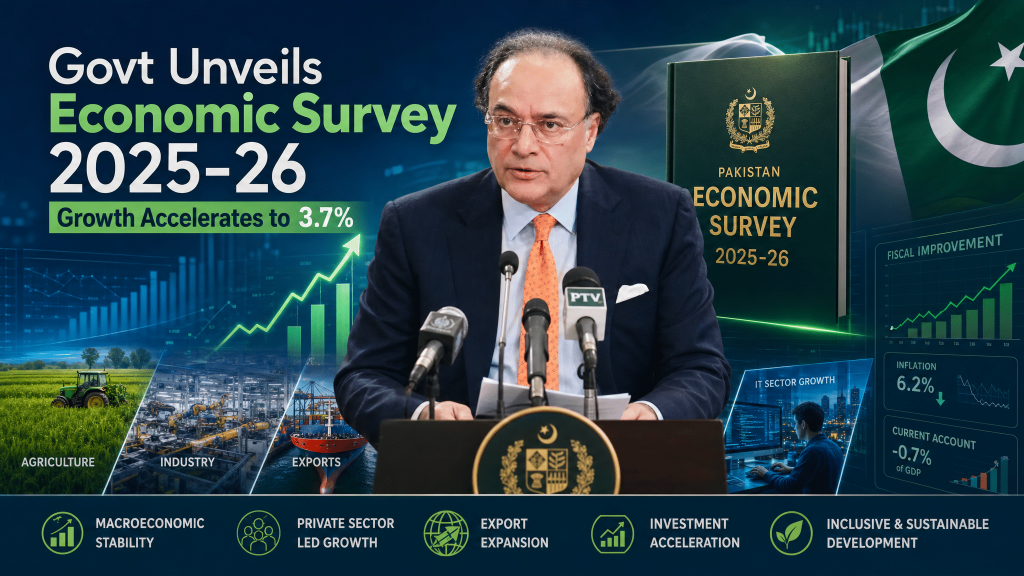
Federal Minister for Finance Muhammad Aurangzeb presented the Economic Survey of Pakistan 2025-26 in Islamabad on Thursday, highlighting the country’s economic performance during the outgoing fiscal year.
Speaking at a press briefing, Aurangzeb acknowledged that agriculture and industrial growth targets were not fully achieved. He said Pakistan faced several challenges during the year, including global tariff uncertainties, floods in August and September 2025, and a regional conflict earlier this year.
Despite these difficulties, he said the economy remained resilient and continued its transition from stabilization to growth. According to the survey, Pakistan’s economy expanded to $452.1 billion, while per capita income increased from $1,751 to $1,901.
The finance minister said economic growth could have exceeded 4 percent if regional tensions had not affected performance. He noted that several industries recorded positive growth, including cement, fertilizer, and petroleum.
Pakistan’s current account remained in surplus at $72 million during July-March. The services sector grew by 4.9 percent, while 16 of the country’s 22 manufacturing sectors showed improvement. Demand for goods also increased, supported by growth in the digital economy.
Aurangzeb said fiscal discipline helped maintain stability. The fiscal deficit remained at 0.7 percent, while the primary surplus reached 3.2 percent of GDP during the first nine months of the fiscal year.
Inflation continued to decline, averaging 6.7 percent during July-May. Revenue collection by the Federal Board of Revenue increased by 10.1 percent, while foreign exchange reserves rose to around $17.1 billion and are expected to reach $18 billion by the end of June.
The survey highlighted strong support from overseas Pakistanis. Remittances reached a record $33.9 billion during July-May, including a monthly high of $4.3 billion in April 2026. Aurangzeb praised overseas Pakistanis for their contribution to the economy.
Exports from the IT and technology sector reached $3.8 billion during July-April, while freelancers contributed $959 million. Deposits under the Roshan Digital Account program climbed to a record $12.7 billion.
The Pakistan Stock Exchange also saw growth, with the investor base exceeding 563,000 and 11 new companies listed during the year. More than 39,000 companies were registered, bringing the total number of registered firms to over 297,000.
Private sector credit increased by Rs934 billion during July-March, while agricultural financing reached Rs2.162 trillion. The government also increased the allocation for the Benazir Income Support Programme to Rs722.5 billion to support low-income families.
Aurangzeb said privatization efforts were being accelerated for Pakistan International Airlines, First Women Bank Limited, and power distribution companies. He also highlighted ongoing government reforms, including ministry mergers and the closure of several departments under a rightsizing initiative.
According to the survey, Pakistan’s literacy rate reached 63 percent. The finance minister also appreciated the support of the United Arab Emirates, describing it as a reliable partner for Pakistan.
Planning Minister Ahsan Iqbal said Pakistan still needs to develop a stronger export-led economy. He emphasized that long-term growth depends on policy continuity and political stability.
The survey showed mixed sectoral performance. Agriculture grew by 2.8 percent against a target of 4.5 percent, while industry expanded by 3.5 percent compared with a target of 4.3 percent. However, manufacturing exceeded expectations, recording 6.6 percent growth, while large-scale manufacturing grew by 6.1 percent.
The construction sector performed strongly with 5.7 percent growth, while information and communication services expanded by 7.5 percent. Education and social services also exceeded their growth targets.
Among major crops, wheat production increased by 4.3 percent to 29.6 million tonnes, rice production rose by 2.8 percent, and sugarcane output grew by 6.2 percent. Chickpea production recorded an exceptional increase of 50.4 percent. Potato, banana, mango, turmeric, and chili production also showed notable gains.
The livestock sector grew by 3.8 percent during fiscal year 2025-26, contributing significantly to overall agricultural output.
The Economic Survey of Pakistan 2025-26 presents a picture of an economy that remained stable despite domestic and external challenges, supported by strong remittances, improved fiscal management, and growth in key sectors.