

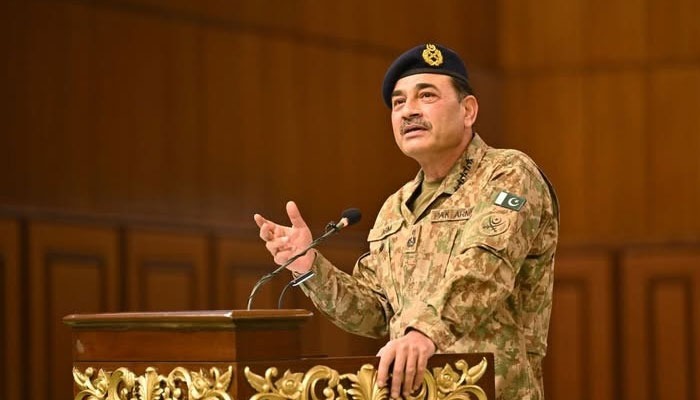
British newspaper Financial Times has described Pakistan’s Chief of Defence Forces and Chief of Army Staff Field Marshal Syed Asim Munir as one of the most effective strategic leaders to emerge during rapid shifts in the global order. In its analysis, the Financial Times said Financial Times Hails Field Marshal Asim Munir as Strategic Leader, highlighting his ability to navigate complex global power dynamics at a time of accelerating change.
Writing for the Financial Times, journalist Alec Russell noted that Field Marshal Munir has adjusted more effectively than most global leaders to the informal and fast-moving diplomatic style associated with US President Donald Trump. The analysis stated that first place for adapting to Trump’s casual approach to world affairs goes to Pakistan’s Field Marshal Asim Munir, underscoring his strategic agility and diplomatic confidence. Financial Times Hails Field Marshal Asim Munir as Strategic Leader by presenting him as a textbook example of a successful middle-power strategist.
The report described Field Marshal Munir as a leading “multi-aligner,” saying he represents the ideal model of a middle power that engages simultaneously with multiple global centers. According to the Financial Times, he moves smoothly from Washington to Beijing and from Riyadh to Tehran, balancing Pakistan’s interests without being locked into a single geopolitical camp.
In contrast, the report pointed to India’s difficulties in adapting to the same global shifts. It observed that New Delhi struggled to engage with Trump’s informal style and found the middle-power strategy more complex than expected. The Financial Times added that this situation has caused frustration in India, which chose not to indulge Trump and is now realizing that playing the middle-power game is harder than initially assumed.
The analysis appeared just a day after The Washington Times described 2025 as a turning point in Pakistan-US relations, citing a dramatic shift in Washington’s approach toward Islamabad. An article by retired Brigadier General Mark Kimmitt stated that at the start of 2025, Pakistan’s relationship with the US remained strained, with Islamabad viewed as politically controversial and diplomatically isolated. By the end of the year, however, Pakistan had re-emerged as a key partner of Washington.
Kimmitt wrote that despite economic challenges and reliance on external financing, Pakistan managed a significant reputational recovery. Analysts had earlier warned that the country could face its most severe national security challenge in over a decade, possibly since the 1990s. Yet by late 2025, Pakistan had shifted from being seen as a pariah to being regarded as a partner, marking one of the fastest and most dramatic reputation turnarounds in recent history. According to the analysis, Pakistan has now become a central pillar of President Trump’s evolving South Asia strategy.
Initially, senior Trump advisers viewed Pakistan with caution due to its close ties with China. The prevailing thinking in Washington was to double down on India, strengthen the Quad, and sideline Islamabad. That approach began to change after a series of quiet counterterrorism exchanges, which signaled Pakistan’s willingness to engage in meaningful cooperation.
The Washington Times article described Field Marshal Munir as emerging as a key figure within Trump’s inner circle, with advisers half-jokingly referring to a growing personal rapport between the two leaders. Insiders portrayed Field Marshal Munir as a disciplined and enigmatic figure who carefully manages his public image. Sensing a strategic opening, Pakistan confidently leaned into the renewed attention.
According to Kimmitt, the shift culminated in a historic White House lunch meeting, the first ever for a serving head of Pakistan’s military. The high-profile engagement rapidly changed the narrative around Pakistan from suspicion to admiration. Within weeks, Field Marshal Munir returned to the US for a red carpet visit to Central Command headquarters, holding high-level meetings with outgoing CENTCOM commander Gen Michael Kurilla and Chairman of the Joint Chiefs of Staff Gen Dan Caine.
As 2026 begins, Pakistan now sits close to the center of President Trump’s emerging grand strategy for South Asia and the Far East, with Field Marshal Asim Munir widely viewed as the driving force behind this strategic repositioning.