


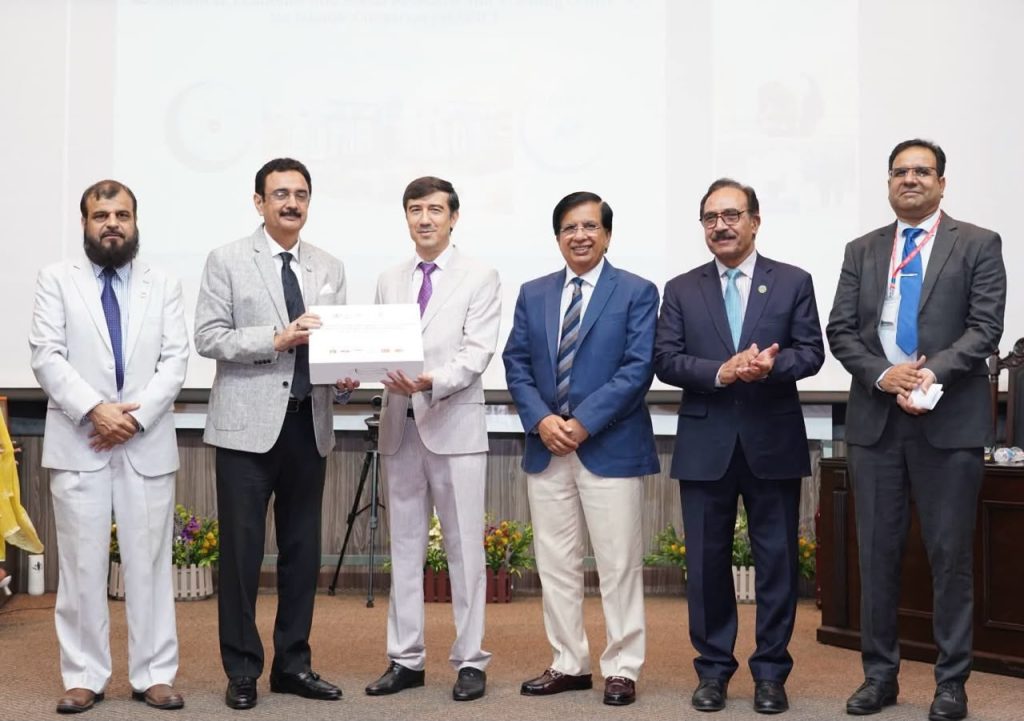
Punjab University’s Centre of Excellence in Molecular Biology (CEMB) has launched a four-day international training program focused on genome editing and crop biotechnology as tools to address climate-related agricultural challenges. The program, organized with support from COMCEC and COMSTECH, brought together scientists, students, and policymakers from several countries.
The inaugural session was attended by Punjab University Vice Chancellor Professor Dr. Muhammad Ali, Deputy Head of Mission at the Tajikistan Embassy Marouf Abdurahmon, COMSTECH Advisor Professor Shahid Mahmood Baig, Punjab Agriculture Food and Drug Authority (PAFDA) Director General Dr. Talat Naseer Pasha, CEMB Director Professor Dr. Moazam Ali Rahman, SESRIC representative Dr. Alia (joining online), along with experts from OIC member states, CEMB researchers, faculty, and students.
Vice Chancellor Highlights Role in CRISPR Research
Addressing the gathering, Vice Chancellor Professor Dr. Muhammad Ali described Punjab University as the country’s leading academic and educational institution. He commended CEMB researchers for their contributions to advanced technologies, particularly their work involving CRISPR gene-editing tools.
He welcomed delegates from Tajikistan, Turkiye, Azerbaijan, Bangladesh, and Uzbekistan, encouraging participants to make full use of the training to build both theoretical knowledge and hands-on expertise in genome editing and crop biotechnology.
Tajikistan’s Deputy Head of Mission, Marouf Abdurahmon, thanked CEMB and Punjab University for the invitation, noting that Tajikistan and Pakistan maintain strong and friendly ties in education, culture, science, and technology. He said programs of this nature play a key role in strengthening institutional links between the two countries and opening new avenues for cooperation.
CEMB’s Standing in Regional Science and Technology
Professor Shahid Mahmood Baig said CEMB holds a prominent position among leading scientific and technical institutions in Pakistan and the wider region. He noted that the centre serves as an excellent platform for scientific education, academic exchange, networking, and collaborative research, adding that its faculty ranks among the country’s most accomplished scientists.
CEMB Director Professor Dr. Moazam Ali Rahman said the centre has signed more than 20 agreements with various agri-tech organizations and has built substantial expertise in genome editing. He outlined ongoing research projects and future plans, including the establishment of a clean room facility.
Rahman thanked COMCEC for funding the workshop and acknowledged the support of COMSTECH and PAFDA in advancing research efforts. He also expressed appreciation for the participation of international experts and delegates.
Workshop focal person Dr. Abdul Qayyum Rao introduced the program and thanked COMCEC, COMSTECH, the Vice Chancellor, and the CEMB Director for their support in organizing the event.
Cotton Technology and Industry Collaboration
CEMB scientist and Genetech representative Dr. Idrees Ahmed Nasir said CKC cotton technology developed with CEMB’s support has been successfully delivered to farmers, including growers in Sindh. He noted that the cotton-improvement technologies developed by CEMB are particularly valuable for regions affected by soil salinity.
Irfan, a representative of Four Brothers Group, said the company’s team includes former CEMB students who, drawing on the quality training received at the centre, contributed to the development of seven patents.
At the close of the event, the Vice Chancellor presented commemorative shields and souvenirs to foreign delegates and distinguished guests, while CEMB Director Professor Moazam Ali Rahman, Professor Shahid Baig, and Professor Talat Naseer Pasha presented a souvenir to Vice Chancellor Professor Dr. Muhammad Ali.