


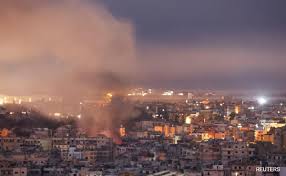
Israel airstrikes on Iran early Monday targeted central and western parts of the country after missile fire from Tehran, marking a sharp escalation in regional tensions.
The strikes come as the conflict reaches its 100th day since the war began on February 28. The fighting started after Israel and the United States killed Iran’s Supreme Leader Ayatollah Ali Khamenei along with several senior Iranian officials, according to earlier reports. A ceasefire was reached on April 8, but hostilities have continued at a lower intensity.
Despite the ceasefire, tensions have remained high due to ongoing clashes, regional instability, and Iran’s control over the Strait of Hormuz, a key global oil and gas shipping route. Fighting involving Israel and Hezbollah in Lebanon has also added to the instability.
Iranian state media reported explosions in Isfahan, Karaj, Tabriz, and Tehran, though no full details were immediately released. A witness in Tehran said at least one large blast was heard west of the capital. Authorities later closed airspace around Tehran’s Imam Khomeini International Airport following the attacks.
Israel confirmed it carried out strikes, saying its air force targeted military sites in central and western Iran. It did not provide further details.
Sirens also sounded in Israel after a missile launched from Yemen was detected. Israeli emergency services said there were no reports of casualties or damage. Yemen’s Houthi movement, which is backed by Iran, has previously launched attacks on Israel but did not immediately claim responsibility for this strike.
In Saudi Arabia, missile alert sirens briefly sounded near an area housing a US military base, including Prince Sultan Air Base in Al Kharj. Authorities later said the threat had passed.
The White House did not immediately comment on the latest developments or whether the United States was involved in coordination.
A US official said President Donald Trump had urged Israeli Prime Minister Benjamin Netanyahu not to retaliate immediately after Iran’s earlier missile strike. The official said Trump believed he had persuaded Netanyahu to delay action, though no formal confirmation was given.
Trump also stated in earlier remarks that Israel’s actions in Lebanon were not coordinated with the United States and expressed frustration over the escalation. He added that Iran should return to negotiations.
The situation has been further complicated by tensions involving Hezbollah in Lebanon, with Israel expanding its military operations in southern areas of the country. The latest strikes raise concerns that the conflict could spread further across the region.