


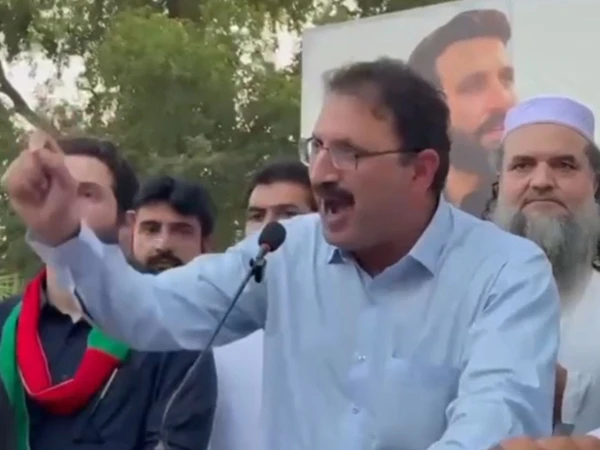
The planned PTI protest in Islamabad on September 27 has triggered a fresh political confrontation, with statements from both the government and PTI leadership raising concerns about the potential impact on law and order in the federal capital. PTI Khyber Pakhtunkhwa President Junaid Akbar has announced that party workers will approach Islamabad through multiple routes, while State Minister for Interior Talal Chaudhry has warned that any attempt to use violence or create disorder will face a strong response.
Junaid Akbar’s statement deserves particular attention because of the language used while announcing the protest strategy. Addressing a workers’ convention in Mardan, he said PTI workers would not rely on a single route to reach Islamabad. He specifically mentioned the motorway, GT Road, Margalla Hills and Dera Ismail Khan as possible routes.
The PTI KP president also referred to the deaths of party workers during a previous protest and said that this time the party would not remain silent after burying its supporters. He further declared that Islamabad would be turned into “ruins”.
This rhetoric goes beyond announcing a political demonstration. When a senior party leader publicly discusses multiple approaches to the capital and simultaneously uses language about turning Islamabad into “ruins”, the government has legitimate grounds to take the possibility of confrontation seriously.
Why Talal Chaudhry’s Warning Matters
Against this backdrop, Talal Chaudhry’s warning about the Islamabad protest can be viewed as a law-and-order response rather than simply another political statement. The State Minister for Interior made a distinction between peaceful political activity and actions that could threaten public safety, saying peaceful citizens would be allowed to come to Islamabad while those engaging in terrorism or unlawful activity would not be permitted to escape accountability.
Chaudhry also said the government would implement the Islamabad High Court’s orders and would not tolerate activities that could endanger lives or property.
That position becomes particularly significant when considered alongside Junaid Akbar’s announcement of multiple routes into Islamabad. A government responsible for protecting the capital cannot ignore statements that suggest a large-scale mobilisation involving several entry points, particularly when those statements are accompanied by highly confrontational language.
The issue is therefore not whether PTI has the right to hold a peaceful protest. Political parties have the right to express their views and mobilise their supporters within the law. The real question is whether the planned Islamabad protest will remain peaceful and comply with court directions and public-order requirements.
Junaid Akbar’s Statement and the Risk of Escalation
The Junaid Akbar threat, as reflected in his own remarks about making Islamabad “ruins”, has created a difficult situation for the authorities. Such statements can increase tensions among workers and supporters before a major political gathering and potentially encourage confrontational behaviour.
His reference to previous deaths also adds another sensitive dimension. Instead of lowering the temperature before the planned protest, the statement could reinforce a sense of confrontation and prepare supporters psychologically for another clash.
The government therefore has a responsibility to distinguish between legitimate political protest and activities that could turn violent. Talal Chaudhry’s warning that unlawful behaviour will not be tolerated is consistent with that responsibility.
At the same time, the government must ensure that enforcement remains lawful, proportionate and focused on preventing violence rather than suppressing peaceful political expression. The credibility of the authorities will depend on applying the same standard to everyone involved.
Information Minister Attaullah Tarar has also accused PTI of seeking to create chaos and destruction and questioned whether the party genuinely intends to hold a peaceful demonstration. These allegations, combined with Junaid Akbar’s remarks, have intensified the political dispute ahead of September 27.
The PTI leadership, meanwhile, has the opportunity to clarify that its workers will remain peaceful and will respect the law, court orders and public property. If the party wants its protest to be viewed as a democratic political activity, its leadership should make clear that violence, destruction and attacks on public institutions will not be tolerated by its own workers.
The responsibility also rests with the government. Strong security measures may be necessary if credible threats to public safety emerge, but peaceful citizens and lawful political activity must not be treated as criminal conduct.
The September 27 Islamabad protest will therefore be a test for both sides. PTI will have to demonstrate that its mobilisation can remain peaceful despite increasingly aggressive rhetoric, while the government will have to prove that its response protects citizens and public property without unnecessarily restricting legitimate political expression.
For now, Talal Chaudhry’s warning appears to be a direct response to the increasingly confrontational tone coming from PTI leaders. Given Junaid Akbar’s statement about approaching Islamabad through multiple routes and his warning that the capital would be turned into “ruins”, the government would be justified in taking potential law-and-order risks seriously.
The most responsible course for all sides is clear: political differences should be settled through democratic and constitutional means, while violence, destruction and threats to public safety must have no place in Islamabad.