


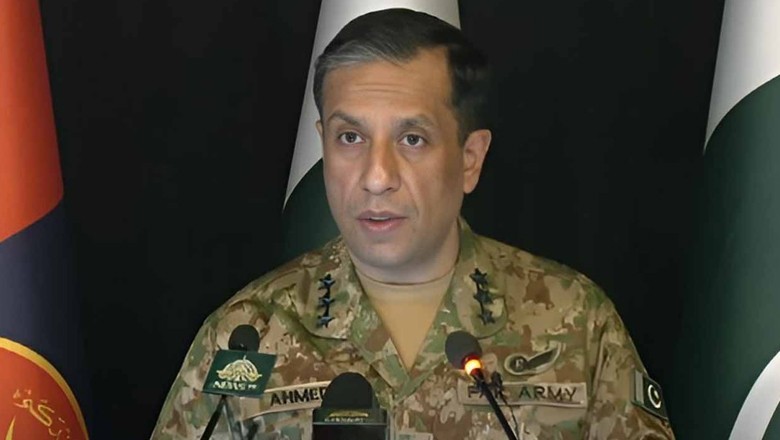
Pakistan’s top military spokesperson has clarified that the Makkah Joint Defence Agreement, signed with Saudi Arabia and Turkiye, carries no offensive intent and is not aimed at expanding influence in the region.
Lt Gen Ahmed Sharif Chaudhry, Director-General of the Inter-Services Public Relations (ISPR), made the remarks during an interview with Al-Arabiya English on Wednesday. He explained that the agreement is built entirely around collective deterrence rather than aggression.
“It is defensive, as the word also implies. There’s nothing aggressive. There are no regional aspirations. It is a collective deterrence,” Lt Gen Chaudhry said.
Background of the Trilateral Pact
The trilateral arrangement was formalized on August 7 between Islamabad, Riyadh, and Ankara, establishing a framework for shared security and defence coordination among the three nations.
Questions around how the Makkah Joint Defence Agreement might be triggered have intensified following repeated Houthi strikes on Saudi cities and energy facilities, which have opened what analysts describe as a second active front in the broader Middle East conflict.
Pact Described as “Complementary,” Not Competing
Lt Gen Chaudhry rejected the idea that the pact conflicts with any signatory’s existing alliances. He characterized it as complementary, noting that each member nation retains independent ties with other countries and blocs.
“So this mutual defence agreement is complementary in nature. It is not competing with any other relationship of all these countries with each other,” he said.
When pressed on how Pakistan would respond if a partner nation came under attack, the ISPR chief said the operational specifics of the Makkah Joint Defence Agreement remain classified, as is standard practice for defence pacts worldwide.
“No country comes out and starts sharing its operational details in any military… It is for the three countries to decide, and it is for them to know and for them to actualise it,” he added.
“Military Conflict Between Nuclear Neighbours Is Out of the Question”
Turning to last year’s four-day standoff with India, Lt Gen Chaudhry said Pakistan delivered a clear message that armed conflict between two nuclear-armed neighbours is not a viable path.
He said Pakistan responded across every domain, air, ground, cyber, sea, informational and diplomatic, calling India’s decision to escalate militarily a “strategic folly.”
The ISPR chief also accused India of internationalizing external disputes domestically, pointing to Kashmir as an issue already recognized by the United Nations Security Council that New Delhi allegedly seeks to suppress through internal repression.
He reiterated that Pakistan’s stance toward India remains rooted in equality and rational engagement. “Pakistan believes in peace on equal terms; Pakistan is a very rational and objective player,” he said, while cautioning that Islamabad would not hesitate to defend its sovereignty if provoked again.
Warning Against False Flag Operations
Lt Gen Chaudhry warned that any attempt by India to stage a “false flag operation” or manufacture a hostile narrative would carry catastrophic consequences.
On the question of preventing an India-Pakistan confrontation from turning nuclear, he said Pakistan’s capability and resolve serve as the strongest deterrent, since any aggression would effectively push India toward mutual destruction.
He further argued that Pakistan’s political and military leadership acted with composure during the May 2025 conflict, while India’s leadership pursued escalation out of “strategic folly and hubris” that its forces could not sustain for more than a few hours.
Recap of the May 2025 Conflict
The confrontation began on May 6 last year, after India launched an unprovoked strike on Pakistan following a militant attack on tourists in Indian Illegally Occupied Jammu and Kashmir’s Pahalgam area.
During the 87-hour conflict, Pakistan shot down eight Indian fighter jets, including French-made Rafale aircraft, along with dozens of drones. The confrontation ended on May 10 through a ceasefire brokered by the United States.