

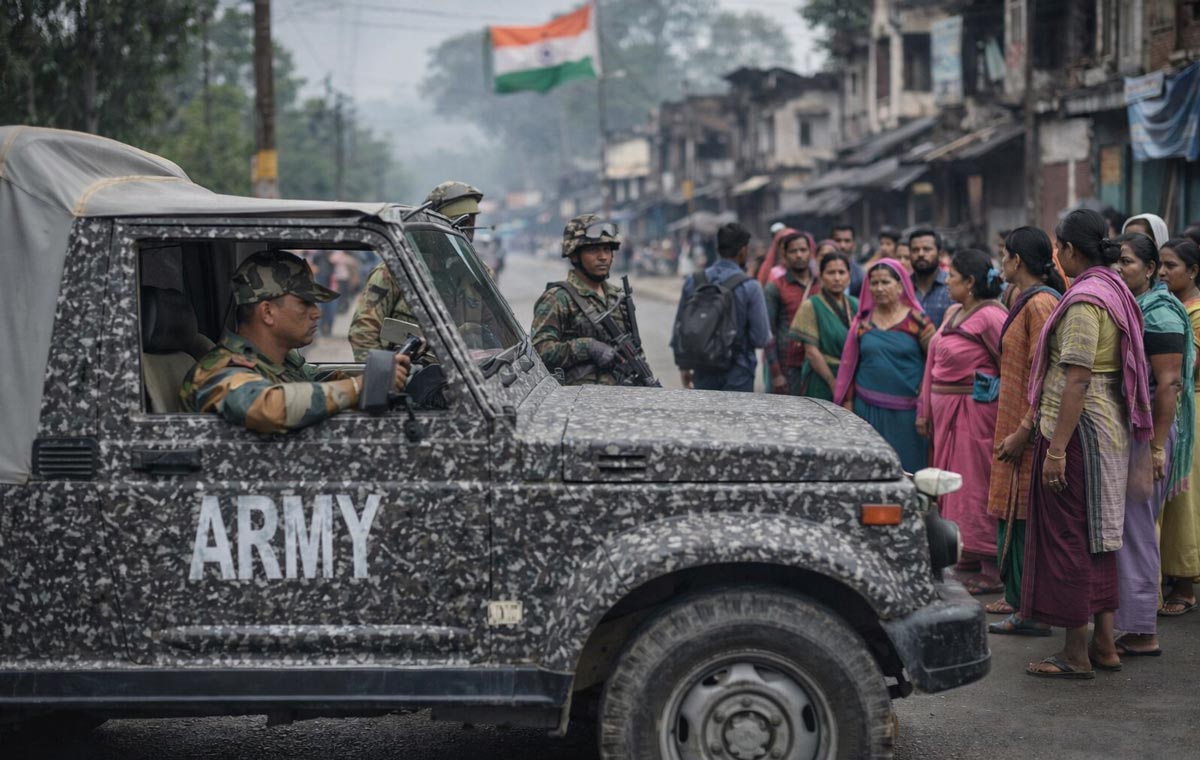
New Delhi: The prolonged unrest in India’s northeastern state of Manipur is increasingly exposing serious cracks in New Delhi’s governance, with peace still elusive even three years after ethnic violence erupted in the region.
According to a recent report by The Economist, the Indian state remains deeply divided along ethnic lines, while public trust in the central government has eroded significantly. Observers say the situation reflects a broader pattern of internal instability within India.
The report notes that policies pursued by the ruling Bharatiya Janata Party (BJP) have failed to bridge divisions between the Meitei and Kuki communities. Instead, political rigidity and delayed responses have allowed tensions to harden, effectively splitting the state on ethnic and religious grounds.
Despite the enforcement of President’s Rule, the Indian government has been unable to restore confidence or normalcy. Anger towards the centre intensified following the 2023 ethnic violence between the Hindu Meitei community and the Christian Kuki population, one of the worst internal security crises India has faced in recent years.
Affected communities have accused the BJP-led government of gross mismanagement, alleging that preventive measures were ignored despite clear warning signs. Rights groups argue that the crisis worsened due to official inaction rather than lack of capacity.
The People’s Union for Civil Liberties (PUCL) described the situation as a case of “state failure,” reporting that nearly 50,000 displaced people — mostly Kuki Christians — continue to live in relief camps under harsh conditions.
Many displaced families reportedly survive on a daily allowance of just ₹84 (around $0.90). The Kuki community has renewed demands for a semi-autonomous administrative arrangement, citing lack of security, justice, and political protection.
Heavy security deployments and widespread checkpoints have paralysed daily life, while legal remedies have so far failed to deliver relief to affected communities.
From a regional perspective, analysts warn that the unresolved Manipur crisis underscores India’s growing internal contradictions, weakening its claims of stability and democratic governance. Prolonged misrule risks reviving old separatist movements, posing long-term challenges for India’s internal cohesion.