


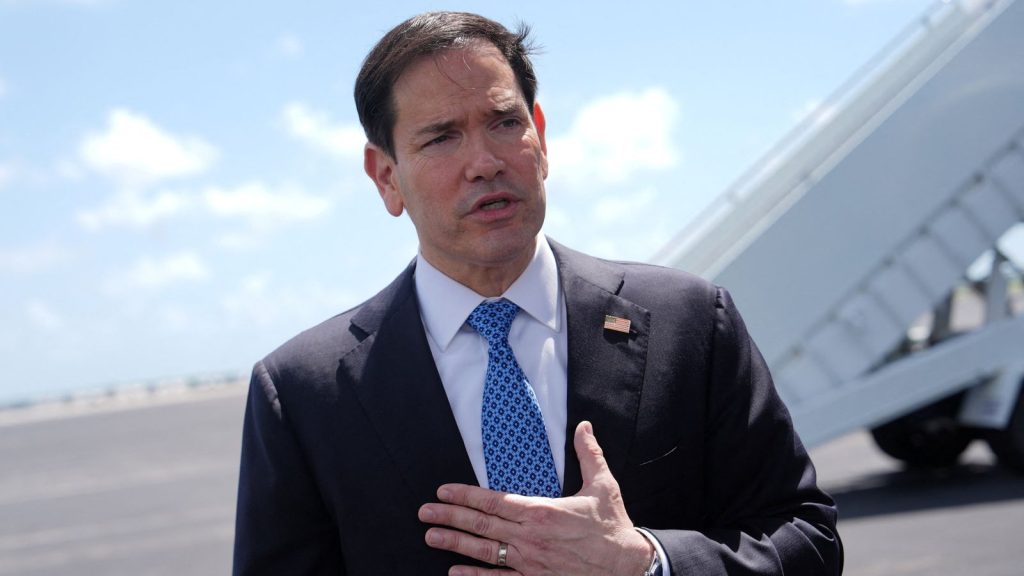
US Secretary of State Marco Rubio has said that a Pakistani delegation involved in ongoing US-Iran talks could arrive in Tehran as early as today. His remarks highlight growing diplomatic activity aimed at finding a possible breakthrough in the nuclear standoff.
Speaking to reporters before departing for Sweden to attend a NATO meeting, Marco Rubio confirmed that Pakistan is playing a mediating role between Washington and Tehran. He added that the United States still wants a successful negotiation with Iran and is actively pushing for progress.
Marco Rubio said there have been positive signals in the discussions so far, suggesting that a possible agreement is still on the table. However, he made it clear that no final deal has been reached yet and the situation remains uncertain. He added that the coming days will be crucial in determining the outcome.
He also reiterated Washington’s firm position that Iran must not be allowed to develop nuclear weapons, a central issue in the ongoing talks.
At the same time, Marco Rubio is set to meet NATO allies for the first time since President Donald Trump raised concerns about the alliance’s role in the Iran conflict and announced plans to withdraw thousands of US troops from Europe.
Before the NATO foreign ministers’ meeting in Sweden, Marco Rubio said President Trump was “very disappointed” with some NATO members who refused to allow the US to use military bases during the conflict. He specifically criticized Spain for its stance, questioning its commitment to the alliance.
Trump has also sharply criticized NATO countries for not doing enough to support the US-Israeli military campaign. He has even suggested that the United States could reconsider its participation in NATO, creating fresh uncertainty within the alliance.
European members, however, have defended their position, saying the US never formally requested NATO to join the Iran war. Many allies have still provided airspace access and logistical support where possible.
Concerns within NATO have further increased after the US decision to withdraw 5,000 troops from Europe. Officials have linked the move to disagreements over war strategy and criticism of Trump’s approach to Iran.
Additional changes have also been announced, including the cancellation of planned missile deployments and a reduction in US military commitments to NATO operations. These moves have raised questions about long-term US engagement in Europe.
Despite tensions, NATO’s top military leadership has tried to reassure allies that any troop reductions will happen gradually. US Air Force General Alexus Grynkewich said the transition will take years, giving European countries time to strengthen their own defense capabilities.
He also noted that as Europe takes more responsibility, the US may focus only on providing critical support that allies cannot yet deliver.
On broader global issues, Marco Rubio said the US prefers a diplomatic solution regarding Cuba and confirmed that America has reached record energy production levels. He also said efforts are underway to prevent the spread of the Ebola virus into the country.