

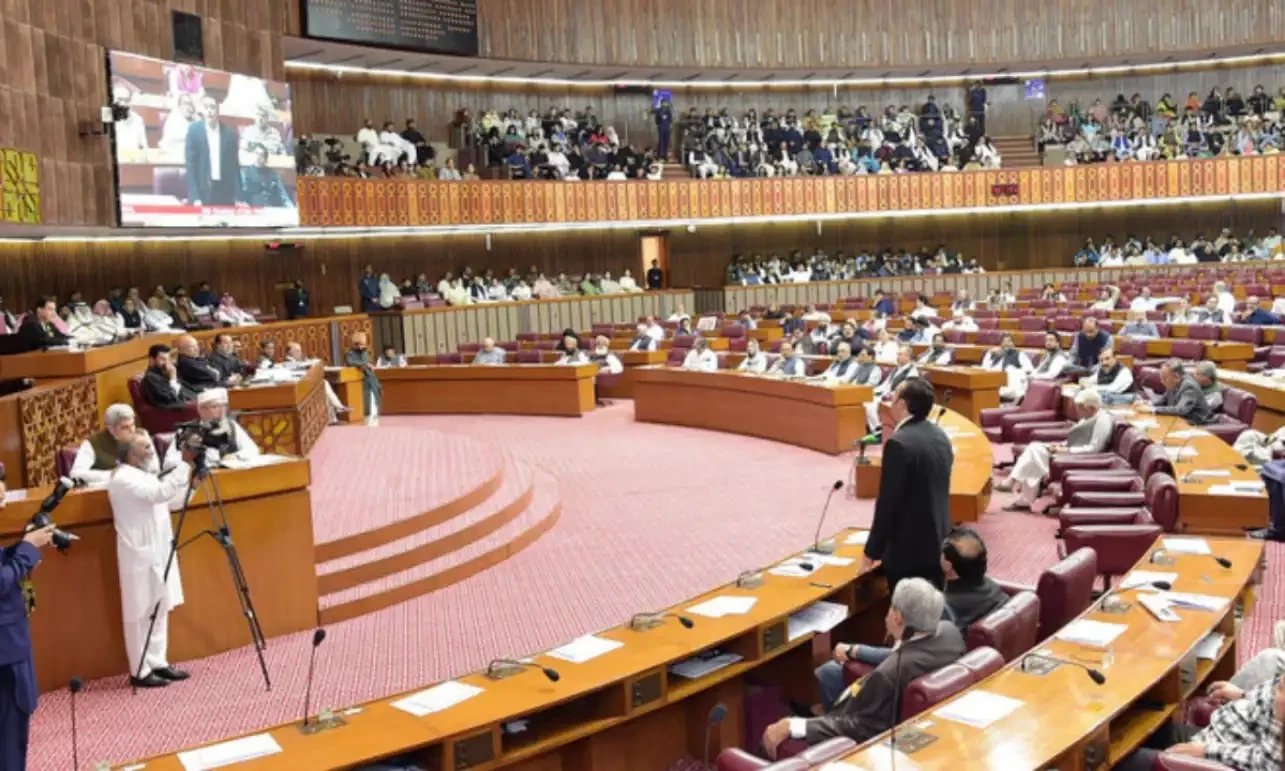
Islamabad: The National Assembly has passed another set of amendments to the Elections Act 2017, approving the Elections (Amendment) Act 2026, which will come into force immediately.
According to parliamentary proceedings, the bill was moved by PPP MNA Shazia Marri and introduces major legal changes, including an expanded role for the Federal Constitutional Court in election-related matters and new rules governing the publication of lawmakers’ asset details.
Federal Constitutional Court Given Role in Election Disputes
Under the approved amendments, several sections of the Elections Act have been revised to replace the term “Supreme Court” with “Federal Constitutional Court”.
- Section 9 has been amended to include the Federal Constitutional Court
- Section 66 now formally brings the court within the jurisdiction framework
- Section 104 and 104A have been amended to assign election dispute matters to the Federal Constitutional Court
As a result, election-related appeals, disputes, and legal interpretation under election laws will now fall under the jurisdiction of the Federal Constitutional Court.
Assets of Lawmakers Not to Be Published Without Approval
The National Assembly also approved a key amendment to Section 138 of the Elections Act, granting the Speaker of the National Assembly or the Chairman Senate the authority to withhold publication of asset details of members.
According to the amendment:
- Asset details will not be made public without approval
- Assets may be kept confidential in case of security or life threats
- The Speaker or Chairman must provide written reasons for such a ruling
Under the law, asset details can be kept confidential for up to one year, though members are still required to submit complete and accurate asset and liability declarations to the Election Commission of Pakistan (ECP) on a confidential basis.
Appeals and Legal Interpretation Shifted to Constitutional Court
Further amendments were approved in:
- Section 155, replacing Supreme Court with Federal Constitutional Court
- Section 202 (subsections 6 and 7), transferring appellate authority
- Section 212 and Section 232, formally defining the court’s jurisdiction
These changes clarify the role of the Federal Constitutional Court across various legal forums dealing with election matters.
Balancing Transparency and Personal Security
The statement of objects and reasons attached to the bill states that the amendments aim to balance transparency with fundamental rights.
While public disclosure of assets is considered essential for accountability, the bill notes that unrestricted disclosure could pose security risks to lawmakers and their families. Therefore, personal safety and privacy protection have been identified as key objectives of the legislation.
Under the new law, lawmakers may request confidentiality of their assets if they believe disclosure poses a risk to themselves or their families. In such cases, the Election Commission will be bound to keep the information confidential for one year, subject to the Speaker’s or Chairman’s ruling.
Opposition Raises Concerns
During the debate, Barrister Gohar opposed the bill, arguing that routine election matters were being shifted from the Supreme Court to the Constitutional Court unnecessarily.
Responding to the criticism, Law Minister Azam Nazeer Tarar said many election-related cases had previously gone to the Constitutional Court, including matters such as political party disqualification and floor-crossing, which are constitutional in nature.
He added that it was not feasible for election appeals to be divided between different courts.
Other Bills Tabled
During the session, several other bills were also introduced, including:
- CrPC (Amendment) Bill 2026, referred to a standing committee
- A constitutional amendment bill proposing changes to women’s reserved seats in assemblies
- Constitution (Amendment) Bill 2026, sent to committee for review
- Fatima University of Science and Technology Bill 2025
The Elections Act amendment bill will now be presented before the Senate for further consideration.