


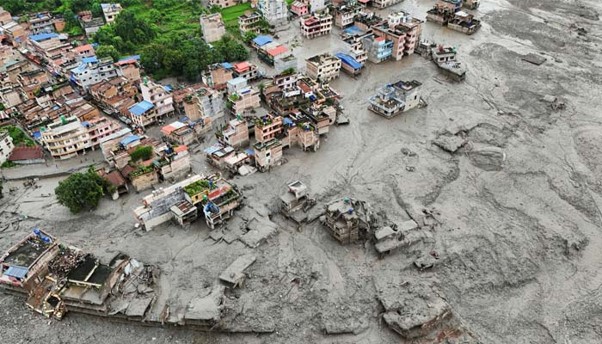
TRISHULI/BEIJING — Helicopter crews across Nepal resumed search operations on Thursday, combing remote valleys for hundreds of people still unaccounted for after a massive landslide sent debris crashing into a river along the Nepal-Tibet border, triggering flash floods that tore through nearby communities. The confirmed death toll from the Nepal flood disaster has climbed to 162, with officials warning the number is likely to keep rising.
Nepal’s tourism authorities reported that 579 tourists remain missing, more than 400 of them foreign nationals, after the disaster struck a region popular with trekkers and religious pilgrims. Police spokesperson Abi Narayan Kafle told Reuters that recovery efforts had restarted and additional bodies were expected to be found in the coming days.
Foreign Nationals Among the Missing in Nepal Flood Disaster
According to Sunil Sharma, a spokesperson for Nepal’s tourism board, the missing foreign tourists include 47 Americans, 34 Australians, 33 Britons, and 24 Canadians. Separately, Chinese state broadcaster CCTV reported that 558 people remain unaccounted for on the Tibetan side, in Gyirong county, including 260 foreign nationals. It remains unclear whether the figures from the two countries overlap.
Verified footage captured the moment a wall of water and debris swept through a border crossing point in Gyirong, destroying vehicles and buildings. Downstream in Nepal, the flooding tore apart homes, roadways, and hydropower infrastructure.
Survivors Describe Scenes of Chaos and Loss
Sixty-eight-year-old Keshav Prasad Baral, now recovering in hospital, recalled the terrifying moment the disaster reached his home. He described a fast-moving surge of mud that kept climbing higher as it approached. He tried pulling his wife toward the terrace, he said, but she was pulled away by the current before he could get her to safety. He was airlifted out roughly four hours later, but said his wife’s body has not yet been recovered.
Another survivor said he managed to escape by holding onto a mango tree, watching helplessly as the house where he had been working was destroyed by the flood.
Relief Operations and Global Response
In the worst-affected districts, army spokesperson Raja Ram Basnet said helicopters were airlifting in tents, food, and emergency supplies, with support coming from neighboring India. Early assessments from Nepali officials pointed to a possible earthquake as the trigger, potentially destabilizing the base of a glacier and setting off the flooding.
The U.S. Geological Survey later clarified that the seismic signal, initially measured at magnitude 4.4, was actually generated by the collapse of glacial rock and ice rather than a traditional earthquake, followed by a debris flow.
A significant number of the missing tourists were traveling to Kailash Mansarovar, a remote high-altitude pilgrimage destination in Tibet considered sacred by Hindus and Buddhists. Mount Kailash, believed by Hindus to be the dwelling place of Lord Shiva, sits beside the equally revered Lake Mansarovar.
International aid began arriving quickly. The U.S. State Department confirmed it was deploying a disaster response advisor and committing $500,000 in assistance. Canadian Prime Minister Mark Carney called the flooding “absolutely devastating” in a post on social media, while UN Secretary-General António Guterres said UN agencies were mobilizing supplies and personnel to support affected communities in Nepal.
On the Chinese side, state media reported three confirmed deaths and 265 people missing in Gyirong, though officials cautioned the figures were still being verified.
Australian Prime Minister Anthony Albanese confirmed that 34 Australian nationals were among the missing, noting the difficulty of gathering accurate information given Nepal’s limited disaster-response infrastructure compared to wealthier nations. South Korea reported eight of its citizens working at a hydropower project were unaccounted for, while Japan and Malaysia also confirmed missing nationals.
Videos Capture Panic as Floodwaters Swept Through Villages
Security camera footage from the Chinese side of the border showed crowds fleeing a wall of rock, mud, and water that flattened buildings and vehicles in its path. Outside a Nepali army training center used as a rescue coordination hub, worried families from the Nuwakot and Dhading districts gathered seeking updates on missing loved ones.
With hydropower damage cutting electricity to the region, police reportedly used mobile phone flashlights to record the names of missing persons after dark.
Entire neighborhoods were left buried under thick layers of mud, with helicopters flying rescue and survey missions throughout the day. Satellite data analyzed by Planet Labs indicated that an ice-and-rock landslide had unleashed a debris-filled flood along the Lhende River, roughly 20 kilometers northeast of the Rasuwagadhi border crossing between Nepal and China, according to Nepali disaster management officials.
Television broadcasts showed flattened houses, cars swept downstream, and a metal bridge collapsing under the force of the water. Local health worker Tula Bahadur BK, based in Rasuwa, described riverside communities as completely wiped out, adding that five of his own relatives were among the missing.
China’s Xinhua news agency reported that the mudslide struck the Gyirong border port directly, severing road access, communication lines, and power supplies throughout the Shigatse border region. One rescuer, speaking to CCTV, said repeated attempts to reach the Gyirong port had failed, and that drone footage confirmed all access roads to the crossing had been completely destroyed.