

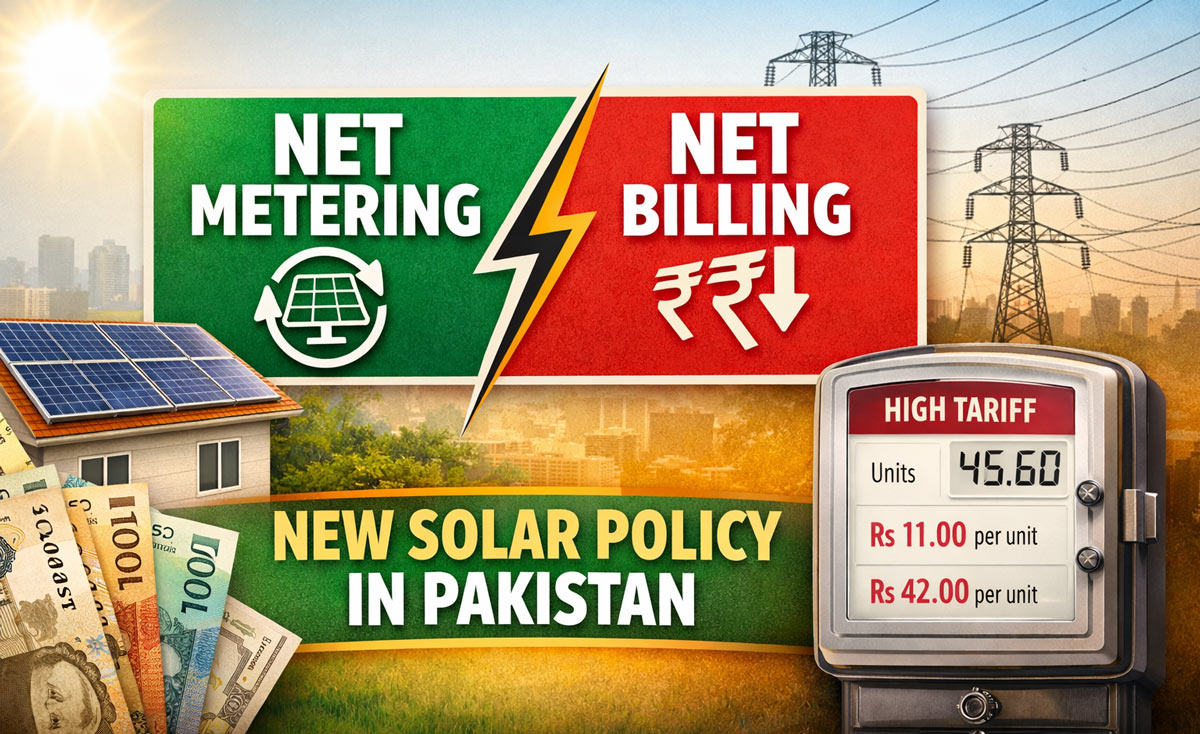
Pakistan’s power regulator NEPRA has introduced a major change for solar consumers by replacing the net metering system with a new model called net billing. The decision has raised confusion and concern among thousands of households that have invested in rooftop solar.
Many people are now asking: what exactly is net billing, and how will it affect existing and future solar users?
What is changing under the new net billing system?
Under the previous net metering system, solar users could offset the electricity they produced against what they consumed. If they exported extra electricity to the grid, those units were subtracted from their bill, often resulting in very low or even zero electricity bills.
The new net billing system works differently.
Solar consumers will now sell their extra electricity to the grid at a much lower rate, while buying electricity from the grid at the regular higher tariff. This means exported and imported units will no longer cancel each other out.
Energy expert Aafia Malik explains that solar users will sell surplus electricity at the national average purchase price — currently around Rs11 per unit — while buying electricity at Rs40–50 per unit or more depending on the tariff.
This pricing gap is the biggest shift in the new policy.
Will old net metering users also be affected?
Yes. According to experts, existing net metering consumers will also be moved to the net billing framework.
However, their original contracts will remain valid for up to seven years. The key difference is how their exported electricity is credited. Instead of quarterly adjustments, exported units will now be credited monthly.
This reduces the financial benefit many early solar adopters previously enjoyed.
What rules apply to new solar users?
For new consumers, the policy is stricter.
NEPRA has limited solar system capacity to a maximum of 1 megawatt, and systems cannot exceed a consumer’s approved electricity load. The aim is to prevent households from installing oversized systems just to sell electricity back to the grid.
At the end of each billing cycle, power companies will calculate:
- electricity consumed from the grid
- electricity generated and exported by solar
- financial adjustment between the two
If a consumer exports more electricity than they consume, the extra amount will either be adjusted in the next bill or paid every three months.
Why is the government making this change?
Energy analysts say the move is linked to falling electricity demand from the national grid.
As more households shift to solar, grid consumption drops. This increases the burden of capacity payments on non-solar users. The government wants to stabilize grid demand and protect the wider electricity system.
However, experts warn the policy could push people toward battery storage systems instead of relying on grid exports.
Aafia Malik says the new net billing structure is less attractive financially, so many consumers may choose to store their own electricity rather than sell it cheaply.
Will net billing reduce solar adoption?
Experts are divided.
Some believe the high cost of grid electricity will continue to encourage solar adoption. Others argue that the reduced incentives may slow down new installations or shift the market toward hybrid solar-plus-battery solutions.
Ziyan Babar, another energy analyst, says it is too early to predict whether the policy will increase grid consumption as intended.
What is clear is that the economics of solar in Pakistan have changed — and consumers will now need to calculate carefully before investing.