


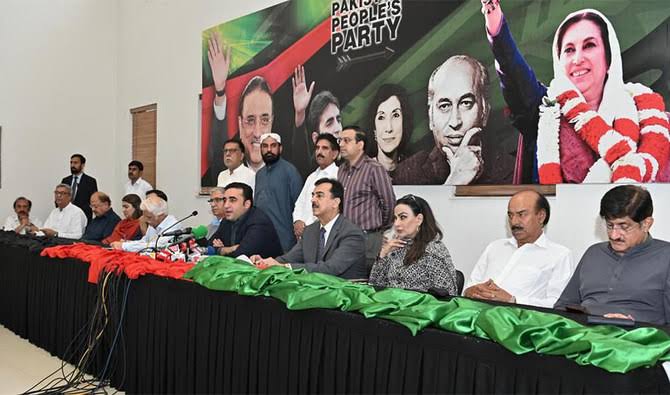
In the grand theatre of Pakistani politics, few performances match the Pakistani Peoples Party’s masterclass in selective federalism. The PPP has long championed the creation of new provinces across the republic. Punjab is too big, they declare. Balochistan needs better governance units. Even the northern areas could use a bit of administrative surgery. Efficiency! Representation! Development! The slogans roll off the tongue like campaign promises after a long night at the party fundraiser.
And then someone mentions Sindh.
Suddenly the music stops. The progressive federalists clutch their pearls. Sindh, they insist, is sacred, indivisible, a civilizational jewel that must never be carved up like a wedding cake at a rival’s reception. Any talk of a new province in southern Punjab’s shadow or a coastal administrative unit is met with accusations of conspiracy, anti-Sindhi plots, and existential threats to the motherland’s most cherished province. The same party that can draw neat lines on maps of other people’s strongholds develops an acute case of cartographic paralysis the moment the pencil approaches the Indus.
Why this charming contradiction? One need not be a political scientist to decode it. Sindh is not merely a province; it is the PPP’s ancestral fortress, its electoral ATM, its reliable vote bank where the family name still opens doors and ballot boxes with remarkable efficiency. Diluting that fortress risks diluting power. New provinces elsewhere, however, can conveniently chip away at the demographic weight of political rivals, particularly in overgrown Punjab, while allowing the PPP to pose as the champion of the underrepresented. It is federalism with a mirror: look closely and you will only see your own reflection looking back with approval.
The party’s defenders will of course insist this is about culture, language, and history. Sindhi identity must be protected. Fair enough until one recalls that the same identity somehow survived decades of internal migration, urbanisation, and political horse-trading without requiring a permanent freeze on administrative reform. Other provinces, it seems, possess identities sturdy enough to withstand division. Sindh’s, by contrast, is portrayed as so fragile that even a polite conversation about better local governance might shatter it.
The satire writes itself. Imagine a doctor who diagnoses obesity in every patient except the one paying his bills. Or a fire brigade that rushes to every blaze in the neighbourhood but draws a firm red line around its own headquarters. The PPP does not oppose new provinces on principle; it opposes them on geography. Where the geography happens to contain the party’s core support, the principle evaporates faster than a monsoon puddle in Thatta.
In the end, the position is less a coherent vision of federalism than a carefully calibrated survival strategy: keep Sindh intact, keep the vote bank intact, keep the narrative of resistance intact. Everyone else can enjoy the progressive benefits of smaller, more manageable units. Just not here. Not on our watch. Not while the math still works in our favour.
Pakistan may one day get the new provinces its size and diversity arguably require. Whether Sindh ever joins that conversation will depend less on high-minded constitutional theory and more on whether the party that has long treated the province as its private preserve decides the political arithmetic has finally changed. Until then, the rest of the country is invited to divide and prosper while Sindh remains, in the party’s eyes, beautifully, permanently, and profitably whole.