


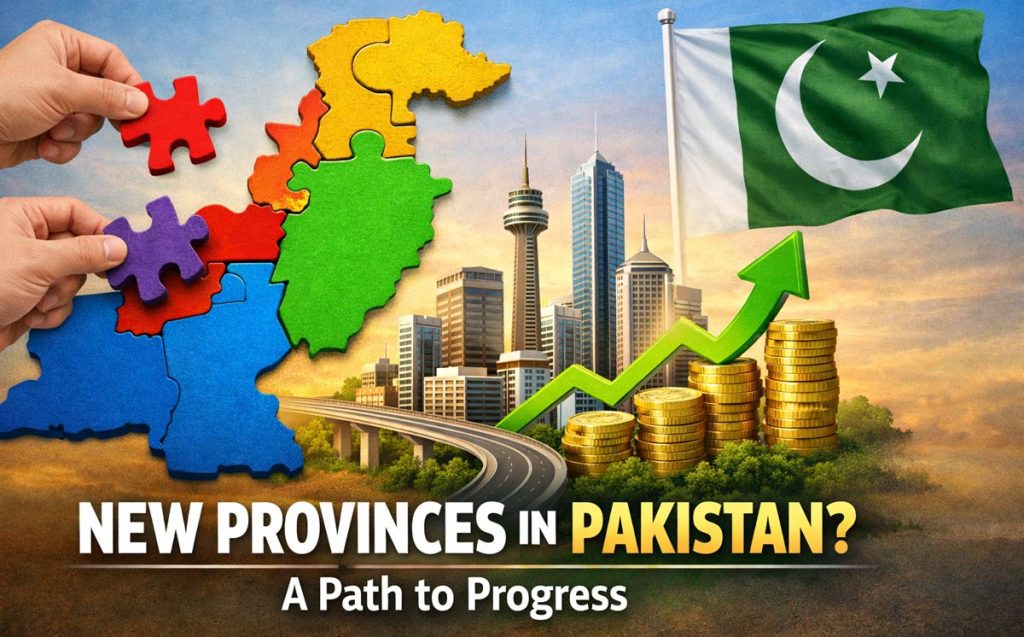
For years, the idea of creating new provinces in Pakistan remained quietly under discussion. Now, it appears that the debate has reached a decisive stage. Policymakers increasingly believe that without administrative restructuring, the country’s governance challenges cannot be resolved.
After years of deliberation within state institutions, a growing consensus has emerged: Pakistan needs new provinces to function effectively. While the ruling PML-N remains divided on the issue, the Pakistan Peoples Party (PPP) currently views the proposal as risky, particularly where Sindh is concerned.
Why New Provinces Are Being Considered
Supporters of new provinces argue that excessive concentration of power and funds at the provincial level has weakened governance. They see administrative division as a remedy for inefficiency, ensuring that authority and resources reach the grassroots.
At present, most development budgets and executive powers are controlled by chief ministers, leaving little room for local leadership to grow. This system has strengthened political dynasties, limited middle-class representation, and widened regional disparities.
Proponents believe that dividing large provinces into smaller, manageable administrative units would:
- Improve service delivery
- Encourage new political leadership
- Reduce elite capture of power
- Ensure balanced development beyond major cities
Under this model, division-level provinces would replace overly centralized provincial structures, with elected chief ministers overseeing empowered administrative teams.
Economic and Political Benefits
Advocates argue that new provinces would allow development to reach smaller cities, rather than remaining confined to Lahore, Karachi, Peshawar, or Quetta. Local governments would be better positioned to address healthcare, education, infrastructure, and employment needs.
Administrative decentralization would also reduce political gridlock at the national level. Instead of endless power struggles, politics would shift toward solving local problems, strengthening democratic accountability.
Political Positions and Resistance
Within PML-N, some leaders support the idea, while others fear that dividing Punjab could weaken the party’s political dominance. The PPP supports administrative restructuring in Punjab but strongly opposes any division of Sindh, particularly separating Karachi.
However, policymakers insist that new provinces would be created on administrative—not ethnic or linguistic—grounds. There are also suggestions that political parties could gain broader representation through leadership roles in newly created provinces.
Addressing Fears of Fragmentation
Opponents warn that creating new provinces could destabilize Pakistan, citing historical examples such as the Soviet Union’s collapse after reforms. They argue that Pakistan’s ethnic and linguistic balance could be disturbed.
Supporters counter this by stating that strong governance, not overgeneralization, keeps federations intact. Countries across the world have strengthened unity by improving administrative efficiency, not by preserving outdated structures.
They also point out that local empowerment does not mean secession, especially when constitutional safeguards remain intact.
An Alternative View — And Why It Falls Short
Some suggest strengthening district governments instead of creating new provinces. However, critics of this approach argue that districts are too small and under-resourced to manage large-scale development.
A more practical alternative, they say, is division-based provinces, which would have the administrative capacity, professional expertise, and financial independence required for long-term growth.
The Way Forward
Pakistan is a diverse and federal state, and its challenges demand modern administrative solutions. After 75 years, revisiting internal governance structures is not only reasonable—it is necessary.
Creating new provinces does not weaken the federation; rather, it strengthens it by ensuring fairness, representation, and equal development.
The debate is no longer about whether reform is needed, but how it should be implemented. The coming days will determine the final shape of Pakistan’s administrative future.