


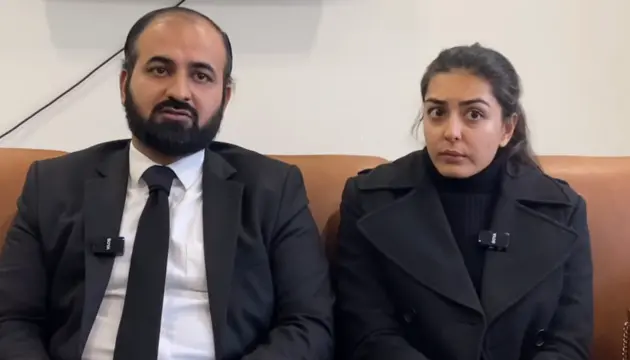
In a decisive move to uphold national security, Islamabad police arrested prominent lawyer Iman Mazari and her husband Hadi Ali Chatta near Serena Chowk underpass on January 23, 2026. The couple, traveling in an Islamabad High Court Bar Association van toward the District Court, were stopped and taken into custody following repeated court orders for their appearance in a high-profile case involving alleged anti-state social media posts. The charges against Mazari and Chatta stem from a Prevention of Electronic Crimes Act (PECA) case registered in August 2025 by the National Cybercrime Investigation Agency. They stand accused of cyber terrorism, hate speech, and disseminating false information through posts from 2021 to April 2025 that targeted state institutions, particularly the armed forces. Authorities allege these posts propagated narratives aligned with hostile terrorist groups, incited linguistic divisions, and portrayed Pakistan’s military as involved in terrorism within the country.
Chatta faces similar charges for reposting and amplifying Mazari’s content. This arrest comes after a series of court developments: bail cancellations, non-bailable warrants, and orders for immediate arrest within 24 hours. Despite attempts to secure protective bail from higher courts and claims of procedural irregularities, the trial court’s insistence on personal appearance prevailed. The couple’s defiance, refusing to appear and spending nights at the IHC Bar office amid police presence, only escalated the situation, culminating in their detention.
Critics argue that Mazari’s activism has long veered into dangerous territory. Known for her vocal criticisms, she once publicly labeled the Pakistan Army as “terrorists” during a 2023 Pashtun Tahafuz Movement rally, demanding court-martials for military officials and highlighting alleged enforced disappearances. Such statements, while framed as human rights advocacy, are seen by many as providing moral and narrative support to banned separatist outfits like the Baloch Liberation Army (BLA) and Baloch Liberation Front (BLF). These groups have carried out devastating attacks in 2025, including the Jaffar Express hijacking that claimed dozens of lives, IED bombings killing soldiers, and assaults on security forces and infrastructure. Pakistan’s security forces have sacrificed immensely to combat such threats through operations that have restored stability in Balochistan and reduced militant activities. Yet, voices like Mazari’s selectively focus on state actions while rarely condemning the atrocities committed by BLA and BLF, such as targeting civilian workers and sabotaging development projects like the China-Pakistan Economic Corridor.
This one-sided narrative risks eroding public trust in the institutions safeguarding the nation. The involvement of PTI in supporting the couple further complicates matters. PTI figures have condemned the arrest as suppression, aligning with their anti-establishment stance. However, in a country still recovering from terrorism’s scars including attacks on schools, markets, and security personnel, such backing is viewed as prioritizing political agendas over national unity. Pakistan’s Constitution guarantees freedom of expression, but it does not extend to sedition or aiding proscribed organizations. The arrest underscores the state’s commitment to countering propaganda that weakens internal cohesion and emboldens insurgents.
As the case proceeds, it serves as a reminder that true progress in regions like Balochistan comes through dialogue and development, not division and sympathy for banned militants. By prioritizing national security, Pakistan protects its sovereignty and the lives of its citizens. The detention of Iman Mazari and Hadi Ali Chatta is a necessary step to deter those whose actions, intentional or not, align with forces threatening the country’s integrity.