


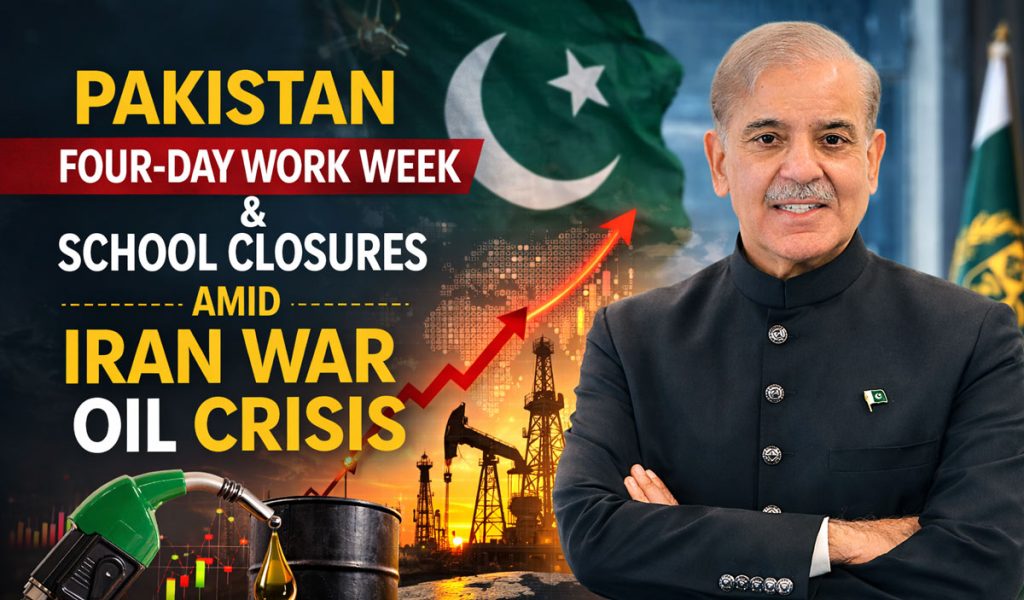
Pakistan’s federal government has announced a series of emergency economic measures, including a four-day work week and temporary school closures, as tensions in the Middle East push global oil prices sharply higher.
The decisions were taken after the ongoing Iran-Israel conflict and rising tensions involving the United States triggered fears of oil shortages and potential disruption in the Strait of Hormuz, a key global energy route.
Prime Minister Shehbaz Sharif said the government had introduced several measures to reduce fuel consumption and control public spending during the emerging energy crisis.
Four-Day Work Week and Work-From-Home Policy
Under the new policy, government and private offices will operate four days a week, while 50 percent of staff will work from home.
The prime minister said the decision was taken to reduce fuel consumption and transport costs during the current crisis.
He explained that Pakistan’s economy depends heavily on oil and gas imports from Gulf countries, making the country vulnerable to international price fluctuations.
Global crude oil prices, he said, have already jumped from around $60 per barrel to over $100 per barrel within days due to the escalating conflict.
Fuel Prices Rise in Pakistan
Earlier this week, the government announced a Rs55 per litre increase in petrol and diesel prices.
According to the prime minister, the increase was necessary due to the surge in global oil prices. However, he said the government tried to keep the hike as low as possible to limit the burden on citizens.
He warned that further increases may be unavoidable if international oil prices continue rising.
Government Announces Austerity Measures
Along with the work-from-home policy, the government introduced several cost-cutting steps aimed at saving fuel and reducing public spending.
Key measures include:
- 50% reduction in petrol and diesel use by government departments for two months
- Federal ministers, advisers and special assistants will not receive salaries for two months
- 25% deduction in salaries of members of parliament
- Senior government officers earning over Rs300,000 will contribute two days’ salary to public relief funds
- 20% reduction in operational expenditures across government departments
- Ban on purchasing furniture, air conditioners and similar equipment in government offices
- Restrictions on foreign trips by ministers and officials except for essential visits
- Preference for online meetings and teleconferencing to save fuel
- Ban on official dinners and iftar events funded by the government
- Government conferences to be held in public buildings instead of hotels
Schools to Close Temporarily
The federal government also announced that schools across the country will close for two weeks, starting later this week.
Higher education institutions will continue online classes during this period to ensure academic activities remain uninterrupted.
Punjab Government Orders School Closures
Meanwhile, the government of Maryam Nawaz has announced additional measures in response to what it called “extraordinary economic challenges.”
According to the provincial government, all schools, colleges and universities in Punjab will remain closed from March 10 to March 31.
However, officials confirmed that examinations will continue according to the scheduled timetable, while institutions can conduct classes online.
Punjab’s education minister Rana Sikandar Hayat said the province had shifted educational institutions to online learning mode due to the economic situation.
Balochistan Also Announces Closures
The government of Balochistan also ordered the closure of all public and private educational institutions until March 23.
Officials said the decision was taken due to transport challenges and potential emergency situations linked to the regional crisis.
However, admissions, school census activities and examinations will continue as planned.
Public Reaction on Social Media
The decision to close schools has triggered mixed reactions on social media.
Some users criticized the move, arguing that education is often the first sector to face disruptions during crises.
Others questioned why schools were closed while markets, restaurants and other businesses remained open.
Several users also expressed concern that students had already faced multiple disruptions this academic year due to smog, floods and security concerns.
Despite criticism, the government maintains that the measures are temporary and necessary to manage the growing energy crisis caused by the escalating conflict in the Middle East.