


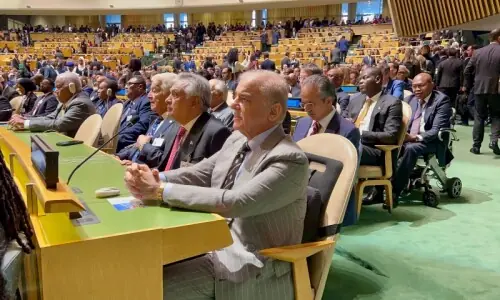
Prime Minister Shehbaz Sharif and Deputy Prime Minister and Foreign Minister Ishaq Dar intensified Pakistan’s diplomatic engagement on the sidelines of the United Nations General Assembly in New York, holding a series of meetings with world leaders. The discussions touched on bilateral cooperation, regional security, and broader diplomatic matters during the high-level segment of the 81st UNGA session.
PM Shehbaz held talks with the leaders of Kenya and Kuwait, and also had informal exchanges with Austrian Chancellor Christian Stocker and Somali President Hassan Sheikh Mohamud.
Shehbaz Meets Kenyan President Ruto
In his meeting with Kenyan President William Ruto, both leaders reaffirmed their commitment to deepening ties between the two nations. They reviewed the current state of bilateral relations and expressed satisfaction with the progress made so far.
Shehbaz called for expanded cooperation in politics, trade, investment, defence, education, and people-to-people exchanges. He pointed to pharmaceuticals, textiles, surgical instruments, and agriculture as sectors with strong potential for growth, and invited Kenyan investors to explore opportunities in Pakistan, including its Special Economic Zones.
The prime minister also expressed interest in stronger ties with the East African Community and called for increased contact between the business communities of both countries. In response, President Ruto praised Pakistan’s role in helping mediate the recent crisis in West Asia and the Gulf region.
The two leaders further discussed shared regional and global concerns, including sustainable development, peace, and international security, agreeing to make better use of existing frameworks such as Bilateral Political Consultations and the Joint Ministerial Commission.
Talks With Kuwait’s Crown Prince
Shehbaz also met Kuwait’s Crown Prince Sheikh Sabah Khaled Al-Hamad Al-Sabah, reaffirming the strong relationship between Islamabad and Kuwait. The two sides explored avenues to expand cooperation in trade, investment, energy, and human resource development, while also exchanging views on regional and global issues and underscoring the importance of peace and stability.
In separate informal engagements, the prime minister discussed bilateral relations and matters of shared interest with Austrian Chancellor Christian Stocker and Somali President Hassan Sheikh Mohamud.
Dar Raises Afghanistan Security Concerns
Meanwhile, as part of Pakistan’s wider diplomatic engagement at the UNGA, DPM Dar called for concrete and verifiable steps to prevent Afghan territory from being used for terrorism against neighbouring states, particularly Pakistan. He raised the issue during a meeting of the OIC Contact Group on Afghanistan.
Dar expressed concern over the continued presence of militant groups inside Afghanistan and recalled the sacrifices Pakistan has made in its fight against terrorism. Referring to the recent terrorist attack in Kohat, Khyber Pakhtunkhwa, which killed civilians and left many injured, he said the incident highlighted the scale of the threat originating from the region.
He urged the Afghan Taliban to meet Afghanistan’s international obligations, halt support for terrorist organizations, promote inclusive governance, and support the resettlement and reintegration of Afghan returnees. Dar also called for the removal of restrictions on women and girls in Afghanistan, describing them as inconsistent with Islamic principles and the norms of Muslim societies.
He appealed to the international community to provide sufficient funding to address Afghanistan’s humanitarian needs and support its economic development, while reaffirming Pakistan’s continued support for a stable and prosperous Afghanistan at peace with itself and its neighbours.
Dar-Kuwait Talks
Dar separately met Kuwaiti Foreign Minister Sheikh Jarrah Jaber Al-Ahmad Al-Sabah on the sidelines of the UNGA. The two ministers reviewed bilateral relations and welcomed the continuation of high-level contacts between Pakistan and Kuwait, reaffirming their commitment to broadening cooperation in areas of mutual interest.
They also discussed regional and international developments, including the situation in the Middle East, and emphasized the importance of dialogue and diplomacy in resolving outstanding disputes and fostering regional peace and stability.