


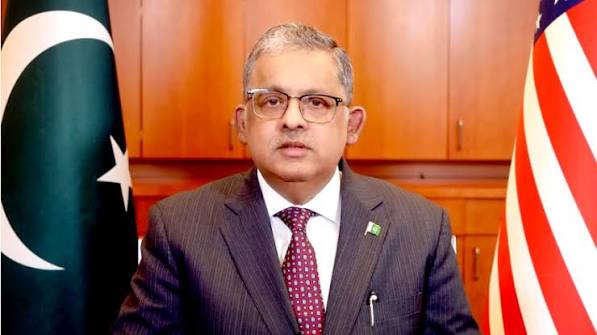
Pakistan’s Ambassador to the United States, Rizwan Saeed Sheikh, has pushed back against India’s characterization of the Indus Waters Treaty as a lopsided arrangement, arguing that New Delhi has misrepresented the pact’s origins, framework, and intent. His remarks appeared in an opinion piece published by Newsweek.
Sheikh wrote that India has repeated this narrative more frequently since announcing in April 2025 that it would hold the Indus Waters Treaty “in abeyance,” a move he described as an attempt to justify, after the fact, a step that has no grounding in either the treaty text or international law.
He pointed out that the agreement was finalized on September 19, 1960, following ten years of negotiations brokered by the World Bank, stressing that it was never a favor extended by India nor a compromise granted to Pakistan. According to Sheikh, dismissing the treaty as unbalanced ignores the specific conditions under which it was drafted and the deliberate equilibrium built into its terms.
Dispute Resolution, Not Obstruction, Says Envoy
The ambassador also disputed India’s suggestion that Pakistan has stood in the way of its hydropower projects. He explained that Pakistan turning to the dispute-resolution process under Article IX represents a legitimate use of rights the treaty itself guarantees, not interference.
Sheikh added that India cannot selectively invoke the treaty’s hydropower provisions while ignoring the technical constraints and resolution mechanisms that come bundled with those same rights under the Indus Waters Treaty.
On the question of legal standing, Sheikh maintained that nothing in the agreement permits either country to unilaterally pause, suspend, or walk away from it. He argued that India’s April 2025 declaration therefore has no power to change the treaty’s legal force, insisting it remains fully valid and binding on both sides.
He further criticized New Delhi for tying unrelated political and security grievances to the treaty, saying that accusations related to terrorism or other bilateral tensions cannot create grounds for one party to unilaterally alter or ignore its obligations under the Indus Waters Treaty.
Warning Over Regional Stability
Sheikh cautioned that weakening the agreement risks turning shared rivers into a tool of pressure, which he said would erode predictability between the two nations and endanger stability in a region already prone to tension.
He closed by reaffirming that Pakistan intends to honor the treaty fully, calling on India to withdraw its unilateral steps, resume complete compliance with its treaty commitments, and return to resolving disagreements through the institutional channels the agreement establishes.