


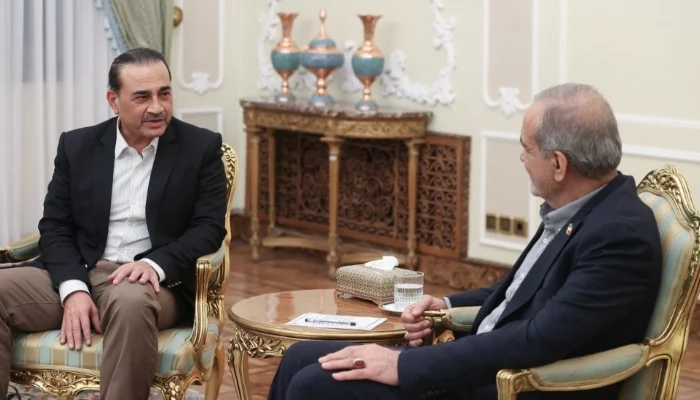
Pakistan and Iran have engaged in high-level talks aimed at the Strait of Hormuz reopening and securing a swift end to the ongoing US-Iran conflict, according to a statement issued by the Inter-Services Public Relations (ISPR) on Tuesday.
The talks were held during a day-long visit to Iran by Chief of Defence Forces and Chief of Army Staff, Field Marshal Syed Asim Munir, who met with senior Iranian officials as part of the trip.
Army Chief’s Tehran Visit Focuses on De-escalation
Field Marshal Munir arrived in Tehran on Sunday, with the military’s media wing describing the trip as part of Islamabad’s broader push to help resolve the standoff between Washington and Tehran.
During his stay, he held meetings with Iranian President Masoud Pezeshkian, Mohsen Rezaei, who represents the supreme leader on the Supreme National Security Council, Parliament Speaker Bagher Ghalibaf, Foreign Minister Abbas Araghchi, and Interior Minister Eskandar Momeni.
ISPR noted that the conversations centred on preventing the situation from escalating further, working toward the Strait of Hormuz reopening, and pursuing an expedited termination of hostilities. Both sides also discussed broader regional stability and possible paths toward a negotiated resolution of outstanding disputes.
The visit unfolded against a backdrop of heightened tension, following Washington’s decision to roll out an expanded package of sanctions that US officials described as an effort to choke off Iran’s economic lifeline and warn other nations against continuing trade with Tehran.
Naqvi Calls Meeting “Positive and Productive”
Interior Minister Mohsin Naqvi, who travelled alongside the army chief, said afterward that Pakistan had made meaningful headway in its efforts toward ending the US-Iran conflict. Writing on X, he described the sit-down with Iran’s president as a “very positive and productive meeting.”
Naqvi said discussions touched on the broader Middle East tensions, the trajectory of the standoff, and what steps both nations would need to take to revive the Islamabad memorandum of understanding, which was originally meant to pave the way for a comprehensive settlement.
He added that the Iranian president had openly shared his government’s concerns and perspective, calling the exchange constructive. Naqvi said the meeting wrapped up on an encouraging note, expressing hope that the momentum generated could help build toward lasting peace in the region.
Pakistan has positioned itself as a central mediator between Tehran and Washington since the conflict erupted following US and Israeli strikes on Iran on February 28. Islamabad had earlier brokered a two-week ceasefire on April 8, pausing six weeks of fighting, and has continued facilitating communication between the two sides since then.
Iran Warns of Retaliation Over Expanded US Sanctions
Separately, Iran signalled it would respond to Washington’s newly expanded sanctions, which US officials said were designed to cut off the country’s economic lifeline. Tehran expressed confidence that its key trading partners would push back against the American pressure campaign.
US Treasury Secretary Scott Bessent announced the measures on Monday, though he held back from imposing the harshest possible penalties. He warned that nations continuing to trade with Iran could risk being cut off from the dollar-based financial system, but did not name specific countries or a timeline for enforcement, saying he wanted to give them a window to comply.
The Treasury Department confirmed sanctions against 60 individuals, entities and vessels, notably leaving out any Chinese financial institutions believed to be involved in facilitating Iran’s oil exports.
Ahead of the announcement, Iran had already warned of a potential military response and hinted it might further cut Gulf oil exports if Washington pressed ahead with economic measures. Following the sanctions rollout, Iranian Economy Minister Ali Madanizadeh said the country was fully prepared, adding that Iran had its own tools to counter what he called an economic attack, and that its defensive posture was shifting.
Madanizadeh also claimed that neither China nor Russia had accepted the new US measures and predicted that other nations would follow suit in resisting them. Meanwhile, Brigadier General Hossein Mohebbi, spokesperson for Iran’s Islamic Revolutionary Guard Corps, warned of serious retaliation against US interests and energy infrastructure should Iran’s own infrastructure come under threat, according to Press TV.