


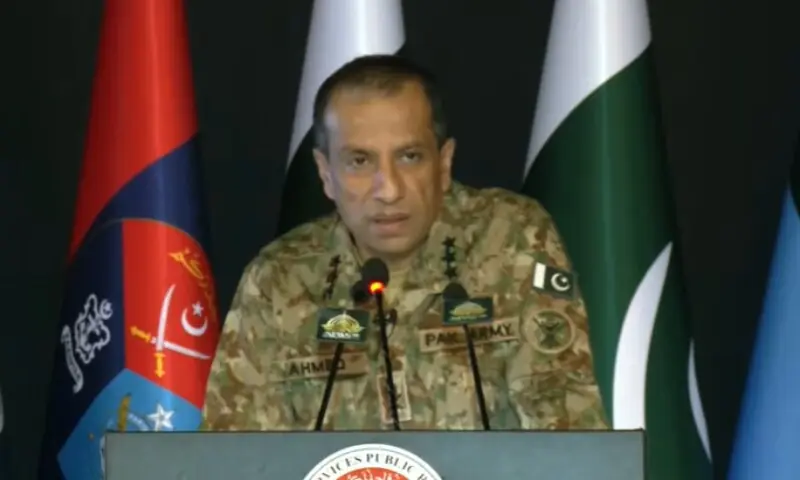
Pakistan’s military spokesperson Lt Gen Ahmed Sharif Chaudhry has put governance failures at the center of the country’s security debate, arguing that unresolved administrative problems are directly tied to the state’s ability to protect its citizens. Speaking at a press conference on counterterrorism and national security, Inter-Services Public Relations (ISPR) Director General Lt Gen Ahmed Sharif Chaudhry said Pakistan’s good governance and security challenges cannot be separated from one another, and that unresolved issues point to a need for administrative reform.
Chaudhry told reporters that when problems persist without resolution, it signals a gap that needs to be filled through better governance. He declined to weigh in directly on recent comments by Interior Minister Mohsin Naqvi, describing them as Naqvi’s personal viewpoint rather than an official military position. Naqvi had said a day earlier that Pakistan’s existing administrative system had broken down and could no longer keep pace with the country’s problems, calling instead for new administrative units, whether labeled provinces or something else.
ISPR Chief Calls for Public Awareness Over Confusion
Rather than commenting on the specifics of Naqvi’s proposal, the ISPR chief said Pakistan’s 14-point National Action Plan already reflects consensus among the country’s political parties. He urged politicians to focus on informing the public rather than adding to confusion, and stressed that neither police nor the armed forces can succeed against militancy and smuggling networks without public backing.
According to Chaudhry, any changes to the governance system should be pursued through constitutional means and should reflect public sentiment. If people are satisfied with how they are governed, he said, that is a positive indicator; if not, reform should still happen within a constitutional framework. He added that an administrative reset should proceed if that is what good governance ultimately requires, noting that work on improving governance was already underway.
No Talks With Terrorists, ISPR Says
Turning to Balochistan, Chaudhry dismissed suggestions that the province’s security situation is deteriorating, calling such narratives inaccurate. He argued that certain elite figures and tribal leaders, or Sardars, in the province have resisted progress for children from poorer families, and stated that the military’s engagement is with the people of Balochistan rather than with armed groups.
He also rejected the idea that Pakistan operates as a “hard state,” defining that term as one where law applies equally to everyone regardless of position, and clarifying that a hard state does not mean military control of civilian affairs. He said Pakistan continues to face an organized negative propaganda campaign built around the situation in Balochistan.
On the contentious issue of missing persons, Chaudhry said a dedicated commission has logged 201 applications and questioned the accuracy of existing missing-persons lists, noting that some individuals killed during counterterrorism operations, or found active in militant camps, had mistakenly appeared on those lists.
Describing Balochistan’s security landscape, the ISPR chief pointed to the province’s difficult terrain and vast distances between security posts, noting a population of roughly 14.89 million spread across the region. He attributed much of the unrest to groups involved in terrorism, robbery, narcotics trafficking and diesel smuggling, while maintaining that ordinary Balochistan residents remain the province’s true stakeholders. On the question of negotiating with militants, he was unequivocal: surrender or face continued military operations, he said, ruling out any further talks.
Counterterrorism Operations by the Numbers
Chaudhry opened the briefing with a statistical overview of operations conducted this year. Security forces have carried out over 40,000 operations, resulting in more than 2,000 confirmed militant deaths, an average of around 10 per day. Khyber Pakhtunkhwa alone accounted for nearly 2,000 of those operations. Pakistan’s own losses this year include hundreds of security personnel and civilians, and the country recorded 28 suicide attacks, several of which the ISPR attributed to Afghan nationals, including recent incidents in Tank and Karachi.
On missing persons more broadly, Chaudhry said publicly circulated figures vary widely, from roughly 10,000 to 20,000, and that a commission set up to investigate such cases has received thousands of applications from Balochistan alone, with the majority of those identities already verified. He reiterated that a number of people once listed as missing were later confirmed to be militants killed in operations.
He also detailed a string of attacks on police and Levies personnel in Balochistan, noting a triple-digit number of martyrs, dozens of abductions and the destruction of two dozen bridges over the past year. The briefing included tributes to police personnel killed in the province, with Chaudhry describing their sacrifice as an honor. He cited specific incidents, including an assault in Kachhi last October where police held their ground and repelled attackers, and a large-scale attack on a police station in Dhadar in April, which he said was followed by coordinated online propaganda, including content amplified by sections of Indian media and hundreds of Indian-linked websites. He further alleged that hostile networks have used online honey-trapping and blackmail tactics to target young women.
Kashmir Remains Central to Pakistan’s Position
Addressing the Kashmir dispute, Chaudhry reaffirmed Islamabad’s long-held stance that Kashmir remains inseparable from Pakistan, calling it the unresolved business of the 1947 Partition. He said the region’s future should ultimately be decided by Kashmiris themselves through a free and fair process. He criticized India’s security posture in Indian Illegally Occupied Jammu and Kashmir, citing the deployment of close to a million security personnel there, and referenced the 2025 Pahalgam attack as raising questions about the effectiveness of that security apparatus.
He contrasted Pakistan’s 2019 and 2025 military responses to India, describing the more recent one as notably more decisive, and said Kashmir continues to receive significant national attention and resources. Chaudhry maintained that many Kashmiris, despite identifying with their own regional identity, feel a strong connection to Pakistan, shaped partly by their exposure to what he described as RSS ideology.
On developments in Azad Jammu and Kashmir, he said the state has encouraged demonstrators to pursue their grievances through elections and democratic channels rather than pressure tactics, adding that accountability would follow for those found to have acted improperly, even as the electoral process continues.
Ties With Saudi Arabia and the UAE
Chaudhry described Pakistan’s relationship with Saudi Arabia as strategic and deeply rooted, noting the religious significance Saudi Arabia holds for Pakistanis as home to Islam’s holiest sites, with Riyadh serving as custodian and Islamabad as protector of that role. He referenced the mutual defense agreement the two countries signed last September, under which an attack on either nation would be treated as an attack on both.
On the UAE, he called the relationship a close and enduring one between brotherly nations, pushing back against what he described as baseless social media narratives suggesting friction. He noted that no two countries align on every issue, but insisted attempts to manufacture division through propaganda would not undermine the strength of the Pakistan-UAE partnership.