


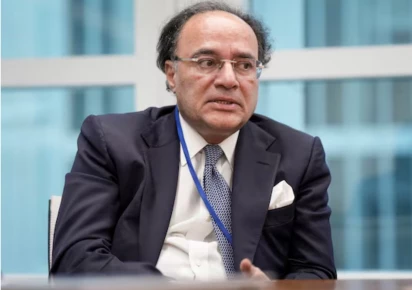
Pakistan Reaches Economic Turning Point, Says Finance Minister Aurangzeb as Finance Minister Muhammad Aurangzeb said the country has arrived at a decisive stage where economic stability, continued reforms and policy continuity have restored confidence. In an interview with the US newspaper USA Today, he said this renewed stability is opening fresh opportunities for both domestic and international investors and placing Pakistan on the path of sustainable, long-term economic growth.
He said macroeconomic stability, falling inflation and improvement in external accounts made this transition possible. According to him, Pakistan is now promoting export- and productivity-led growth by tapping emerging potential in agriculture, mining, technology and climate resilience. He said these sectors can drive durable expansion and reduce long-standing economic vulnerabilities.
The finance minister said that for the first time in many years, Pakistan has achieved both a primary fiscal surplus and a current account surplus, which reflects a clear break from the cycle of persistent deficits. He credited stronger remittances for playing a central role in this turnaround and said inflation has declined sharply from a peak of 38 percent to single digits.
He said foreign exchange reserves have crossed 14.5 billion dollars, enough to cover nearly two-and-a-half months of imports. He added that exchange rate stability has helped rebuild investor trust and reduce uncertainty in the market.
While highlighting these gains, Aurangzeb said sustainable growth remains Pakistan’s biggest challenge. He said economic growth of 2.7 percent in the previous fiscal year marked progress but still falls short of meeting the needs of a fast-growing population. He said the government is deliberately shifting away from a consumption- and debt-driven model toward an export-led economic strategy.
He said the current budget reflects this shift and includes structural reforms in taxation, energy pricing and state-owned enterprises. According to him, Pakistan is aligning its economic direction with changes in global demand, while IT services, textiles and agricultural exports stand out as sectors with strong growth potential.
He said the government is also simplifying the tax system for exporters and reducing bureaucratic hurdles to improve productivity and competitiveness over the long term. He added that privatisation of state-owned enterprises, revenue liberalisation and restructuring of the energy sector aim to fix deep-rooted structural flaws that have weighed down public finances for decades.
Aurangzeb said these reforms form part of a long-term vision that aligns with the World Bank’s assessment of Pakistan’s potential East Asia moment. He also referred to the ten-year Country Partnership Framework with the World Bank, the first of its kind, which focuses on economic reform, climate resilience and population management.
He said Pakistan’s future does not depend only on financial indicators but on addressing existential challenges such as rapid population growth, climate change, child malnutrition, poor education outcomes and the exclusion of girls from schooling. He stressed that women’s education and participation in the workforce remain both a social necessity and an economic requirement.
The finance minister said Pakistan is modernising its regulatory framework to encourage innovation and attract foreign investment, particularly from the United States. He described technology as a major game changer for the country’s economic transformation.
Pakistan Reaches Economic Turning Point, Says Finance Minister Aurangzeb as he concluded by inviting global investors and partners to engage with Pakistan through trade, investment and cooperation. He said the country is moving away from a crisis narrative toward opportunity, reform and transformation, with strong prospects as an emerging market on the threshold of sustainable growth.