


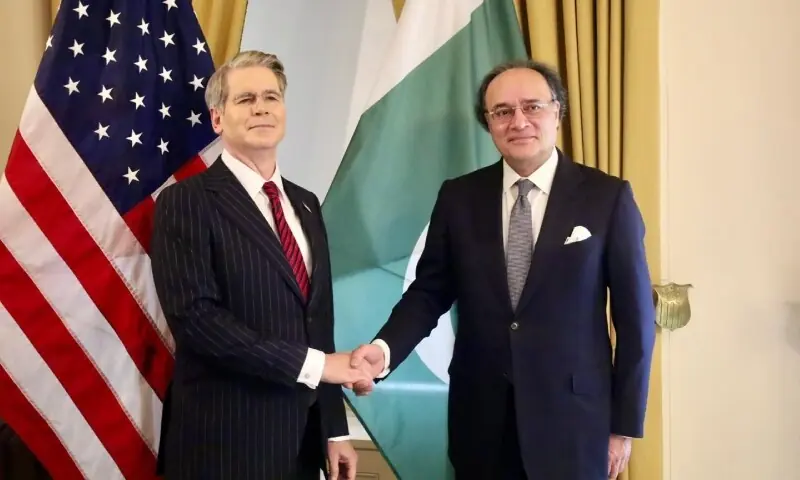
Pakistan has formally approached the United States for a $10 billion exchange stabilisation facility, a person familiar with the matter has revealed, in a move that could offer significant relief to the country’s strained finances.
This previously unreported request comes on the heels of Pakistan’s involvement in mediating discussions around the US-Iran conflict, an episode that elevated Islamabad’s standing on the world stage and fueled speculation that it might leverage the moment for economic support from Washington and other allies.
Details of the Proposed US-Pakistan Financial Arrangement
The proposal, submitted to US Treasury Secretary Scott Bessent, calls for a bilateral exchange stabilisation support arrangement between the two governments valued at $10 billion, with repayment terms stretching up to five years.
Should Washington agree, the facility would strengthen Pakistan’s foreign currency reserves, relieve strain on the rupee, and lessen the country’s dependence on multilateral lenders, all while Islamabad continues to implement stricter fiscal and monetary measures under its existing IMF arrangement.
The US Treasury did not offer comment when asked about the request, and Pakistan’s finance ministry had not responded by the time of reporting, given the timing outside Asia business hours.
Finance Minister Muhammad Aurangzeb held talks with Bessent in Washington on Tuesday, during which he flagged how exposed Pakistan’s economy is to geopolitical instability in the region, according to a ministry statement that made no mention of the specific funding request.
The ministry noted that Aurangzeb pushed for stronger American backing to help Pakistan gain better footing in global capital markets, build up its reserves, and improve its sovereign credit standing. Both sides reportedly agreed to deepen economic ties, encourage greater US investment, and move forward on strategic projects together.
Pakistan’s Ongoing IMF Commitments
Pakistan continues to operate under a $7 billion IMF programme that has forced through unpopular measures, including tax hikes, tighter spending, and structural reforms.
Exchange stabilisation facilities of this kind are uncommon tools used by the US Treasury, typically drawn from its Exchange Stabilisation Fund, offering dollars, currency swaps, or guarantees to help reserves and currencies stay steady. These differ from the standing dollar swap lines the US Federal Reserve maintains with certain central banks, which function as an ongoing dollar supply channel supporting global financial stability.
Argentina received a similar package in 2025, marking the first new facility of its kind extended to a foreign government since Uruguay’s in 2002, setting aside Mexico’s long-running swap line from the 1940s, now valued at $9 billion.
Pakistan’s Recent Financial History
Pakistan came close to default in 2023 before securing a $3 billion IMF standby arrangement, later followed by a larger $7 billion Extended Fund Facility and an additional $1.3 billion loan aimed at strengthening resilience against climate-related disasters. Even so, its reserve position still leans heavily on official financing, debt rollovers, and deposits from China and Saudi Arabia.
This dependence leaves Islamabad vulnerable to changes in bilateral support or delays in IMF disbursements, a risk that became apparent in April when Pakistan repaid roughly $3.5 billion, about a fifth of its reserves, to the United Arab Emirates, with Saudi Arabia stepping in with $3 billion in fresh assistance.
The State Bank of Pakistan indicated in January that reserves might climb back toward their 2021 peak, potentially reaching $20 billion by the close of 2026.
Reshaping the US-Pakistan Relationship
A US-backed exchange stabilisation facility would serve a dual purpose, functioning both as a financial safety net and a political gesture, easing strain on reserves and the rupee while reducing Pakistan’s reliance on IMF disbursements and one-off rescue packages.
The IMF-driven reform path has brought stability to the economy, though at real political cost, including higher taxes, spending cuts, and less room for development or social spending.
Fitch Ratings noted in April that Pakistan’s continued compliance with its IMF programme has supported its ability to secure funding, and that rebuilt reserves offer some protection against economic shocks stemming from Middle East tensions. Still, the agency warned that climbing energy prices and possible supply chain disruptions could significantly deplete the country’s foreign currency reserves.
Foreign investment into Pakistan has stayed limited, held back by repeated external crises, unpredictable policy, past restrictions on repatriating profits, and a narrow export base. Meanwhile, the country’s credit rating remains firmly in speculative territory, keeping borrowing expensive and market access constrained.
Islamabad has been working to capitalize on its relationship with the Trump administration to tackle some of these challenges, with cooperation already extending into cryptocurrency, real estate, and mining.
Pakistan has entered into a stablecoin agreement for cross-border payments with an affiliate of World Liberty Financial, the crypto venture tied to President Trump’s family. It has also explored a memorandum of understanding to redevelop the shuttered Roosevelt Hotel in New York, owned by Pakistan International Airlines, in partnership with the US government, while courting American mining investment, including at the Reko Diq project, where the US Export-Import Bank has pledged $1.25 billion in financing.
As talks continue, Pakistan’s push for the $10 billion facility underscores how central US financial backing has become to the country’s efforts to stabilize its economy and reduce its dependence on traditional multilateral lenders.