


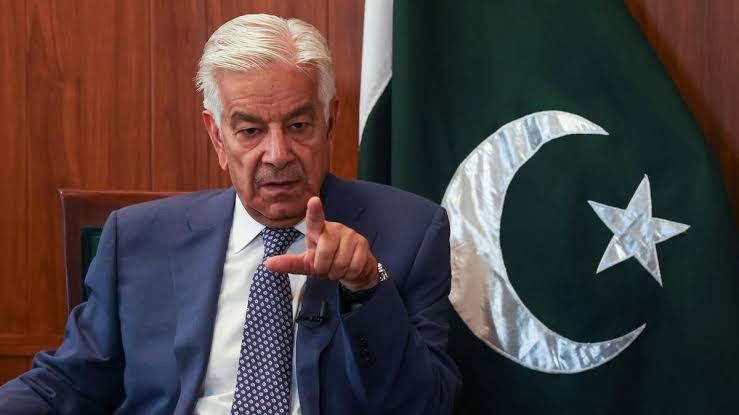
Defence Minister Khawaja Asif said on Wednesday that circumstances had reached a stage where the Makkah Agreement Pakistan is party to would need to be put into effect, following a failed drone strike near the holy city.
Speaking on the private television programme, Asif said the pact applies to Pakistan and that Islamabad intends to honour its commitments, though he declined to elaborate on the agreement’s specific provisions.
He added that Pakistan considers the protection of Islam’s holiest sites a duty regardless of any formal pact. “If Makkah is attacked, there is no need for an agreement to protect it,” he remarked.
Drone Intercepted Near Makkah Prompts Regional Response
Asif’s comments followed an announcement from Saudi Arabia that its air defence systems had shot down a Houthi drone south of Makkah before it could breach restricted airspace over the city.
The interception occurred Tuesday evening and, according to a spokesperson for the Saudi-led coalition operating in Yemen, marked the second such attempt by Houthi forces to target the holy city. Houthi officials rejected the accusation, with spokesman Yahya Saree stating that their operations are aimed at Saudi oil infrastructure and military installations, not religious sites.
Earlier the same day, Prime Minister Shehbaz Sharif reaffirmed Pakistan’s backing for Saudi Arabia’s defence, describing the incident as a “dastardly and heinous attempted drone attack” and pledging that Islamabad stands “shoulder to shoulder” with Riyadh. He called for restraint from all sides, noting the region had already endured significant conflict, and emphasized diplomacy as the only viable route to lasting peace.
Terms of the Trilateral Defence Pact
Asif explained that the agreement includes a mutual defence clause, triggered if the territorial integrity or borders of any of the three signatory nations, Pakistan, Saudi Arabia, and Turkiye, come under threat. He said there was “absolutely no ambiguity” regarding how the pact applies in this situation.
While confirming that Islamabad intends to meet its obligations under the Makkah Agreement Pakistan has committed to, he declined to discuss specific defence or military planning, citing the sensitivity of such matters.
Pakistan’s Message to Iran on Houthi Tensions
Asif also revealed that Pakistan had relayed a message from Saudi Arabia to Iran, addressing concerns over Houthi attacks against the kingdom.
He said he did not expect Iran, as a state, to back the Houthis in a manner that would open a new front in the region. “I don’t think Iran as a state will open another front,” he said, noting that Tehran already faces its own regional conflict.
He drew a distinction between formal state policy and informal networks tied to non-state actors, saying such groups can act independently without state authorization. In his view, Iran taking sides in the Houthi-Saudi conflict would be an imprudent move given Tehran’s broader diplomatic relationships, and he assessed the likelihood of Iran opening another front as minimal. He added that Pakistan would keep working to prevent the conflict from spreading further.
Regional Security Cooperation and US Role
On broader regional security, Asif pointed to the trilateral defence agreement linking Pakistan, Saudi Arabia, and Turkiye as one example of countries reassessing their security needs independently. He noted that additional defence arrangements could take shape across the region, though he clarified this reflected his own analysis rather than confirmed developments.
He suggested that if regional states increasingly need to manage their own security, closer cooperation against non-state armed groups may follow, requiring joint efforts to build frameworks aimed at long-term stability.
Strait of Hormuz and Bab al-Mandab Disruptions Raise Economic Concerns
Asif flagged ongoing disruptions to maritime routes, particularly around the Strait of Hormuz and Bab al-Mandab, as a growing threat to trade and regional economies.
He said these disruptions carry particular weight for Pakistan given their direct impact on the national economy. According to Asif, the broader conflict has expanded well beyond its original scope, with control over shipping lanes now emerging as a central concern.
He reiterated the importance of keeping maritime trade routes functional, warning that continued disruption would carry significant economic consequences for both Pakistan and the wider region.