

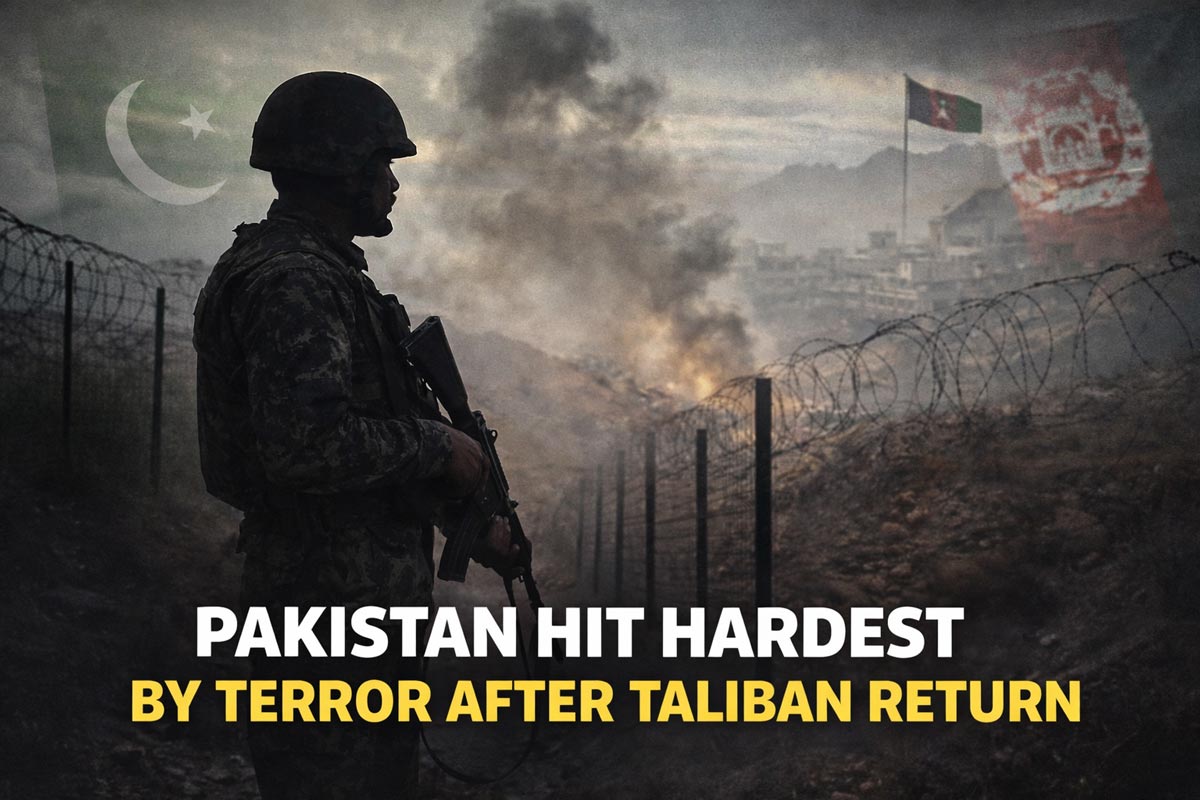
Islamabad: Pakistan has emerged as the country most affected by terrorism following the Taliban’s return to power in Afghanistan in 2021, according to a new report by the International Crisis Group (ICG).
The Brussels-based independent and non-profit think tank stated that while a fragile ceasefire currently exists, continued militant attacks could prompt Islamabad to launch renewed military action. The report notes that relations between Pakistan and Afghanistan have deteriorated sharply, primarily due to the Afghan Taliban’s refusal to take action against the Tehreek-e-Taliban Pakistan (TTP).
According to the ICG, violence inside Pakistan has increased significantly since 2022. In 2025 alone, more than 600 Pakistani army and police personnel were killed in militant attacks, with most casualties reported from Khyber Pakhtunkhwa and Balochistan — provinces bordering Afghanistan.
Islamabad holds the outlawed TTP and Baloch militant groups responsible for the attacks and claims that evidence points to support from Pakistan’s rival, India. The think tank warned that if militant violence continues, Pakistan could once again carry out cross-border operations inside Afghanistan.
The report cites United Nations monitors as saying that the TTP enjoys support from the Afghan Taliban — a claim Kabul denies. Taliban authorities insist that Pakistani militants are not present on Afghan soil and describe the violence as Pakistan’s internal problem.
Tensions escalated after an October 8 TTP attack along the western border killed 11 Pakistani soldiers, prompting Islamabad to conduct air strikes across the border, including its first-ever strike near Kabul. The reported target was TTP chief Noor Wali Mehsud. Afghanistan retaliated by attacking Pakistani military positions, leading to casualties on both sides, including civilians.
The ICG warned that if another major attack is traced back to Afghan territory, Islamabad may respond forcefully again. Although the Taliban government is militarily weaker, its response could still be dangerous. Kabul has claimed it possesses missiles capable of reaching Pakistani cities, raising fears of a severe escalation.
Risk of a New South Asian Crisis
The report highlights that Pakistan’s external relations in South Asia have become increasingly complex. Following brief conflicts with Afghanistan and India in 2025, any major militant attack could shatter the fragile calm currently holding between Pakistan and its neighbors.
The Afghanistan–Pakistan situation has been listed among the 10 global conflicts to watch in 2026, alongside Myanmar, Israel–Iran–US tensions, Israel–Palestine, Syria, Ukraine, Mali and Burkina Faso, Ethiopia–Eritrea, Sudan, and Venezuela.
According to the report, the world had already entered a dangerous phase even before Donald Trump’s return to the White House. His second term has accelerated global instability rather than easing it. The year 2025 proved exceptionally violent, and prospects for 2026 appear no better.
Trump’s Return Further Complicates Global Affairs
The report states that President Trump’s first year back in power has dramatically reshaped global politics and crisis management. He returned to office promising to bring peace to a world in turmoil and positioned himself as a central figure in resolving multiple conflicts.
While Trump renewed focus on deal-making after years of stalled diplomacy, the report argues that his efforts have failed to reduce global disorder and, in some cases, worsened existing crises. His agreements have produced only temporary calm in limited areas, without delivering sustainable peace.
Trump’s approach relies heavily on American leverage — whether through Israel’s dependence on Washington in Gaza or through tariff threats and economic incentives elsewhere. The report notes that regions where Trump has not intervened directly have seen little to no progress.
Meanwhile, European leaders, preoccupied with threats closer to home, have limited capacity to contribute meaningfully to peace efforts in other regions.