

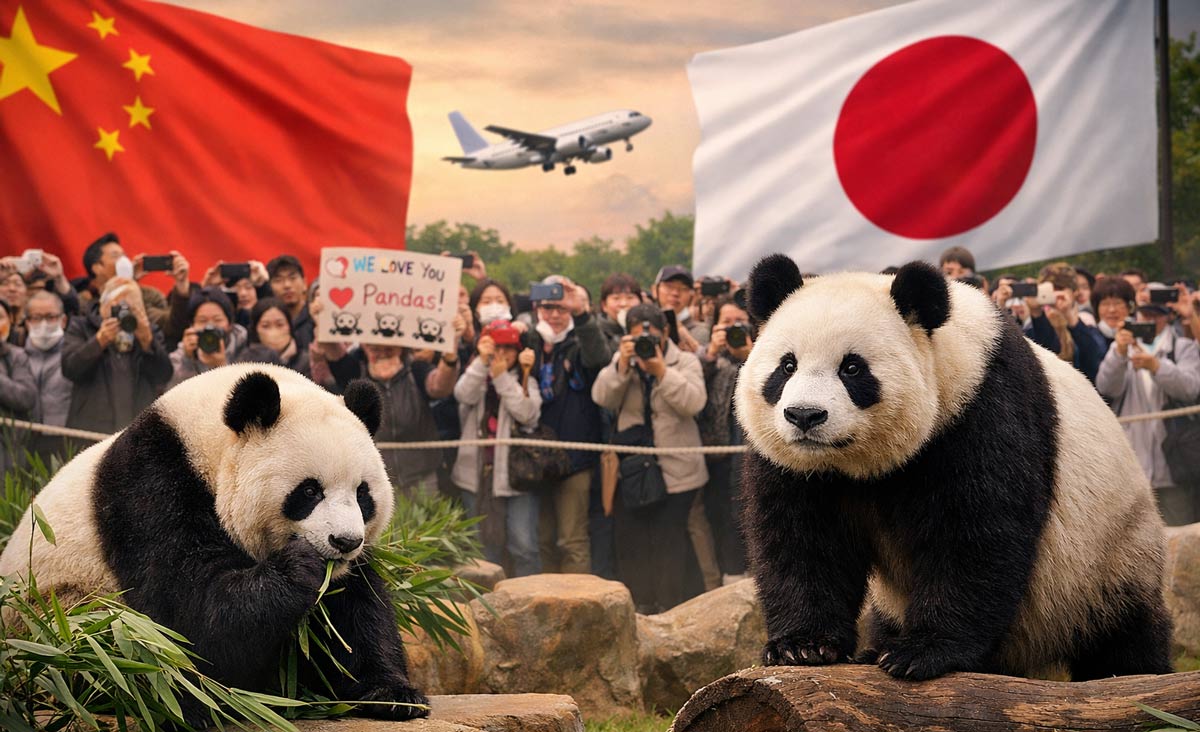
Emotional Farewell Marks a Historic Shift in China–Japan Relations
Tokyo: Panda diplomacy between Japan and China has effectively come to an end as Japan prepares to send back its last two giant pandas to China, amid worsening diplomatic ties between the two Asian powers.
On Sunday, thousands of people gathered at a Tokyo zoo to bid an emotional farewell to the twin pandas Xiang Xiang (Shan Shan) and Lei Lei, who are scheduled to return to China on Tuesday. Long queues were seen outside the zoo, with some visitors waiting over three and a half hours for a final glimpse of the beloved animals.
The farewell scenes were deeply emotional, highlighting the strong public attachment to pandas, which have long been seen as symbols of friendship and goodwill between Japan and China.
A Symbolic End to Panda Diplomacy
With the departure of the twin pandas, Japan will have no giant pandas for the first time since 1972 — the year when Japan and China formally normalized diplomatic relations. The arrival of pandas in Japan at that time marked a new chapter in bilateral ties and became a powerful diplomatic symbol.
China has used “panda diplomacy” since the founding of the People’s Republic of China in 1949, sending pandas to friendly nations — and at times even rivals — as a gesture of goodwill. However, China retains full ownership of all pandas, including cubs born abroad. Host countries typically pay around $1 million per panda pair annually to China under long-term loan agreements.
Rising Tensions Between China and Japan
Relations between Japan and China have recently deteriorated sharply, driven by disputes over regional security, Taiwan, and military influence in East Asia.
Tensions escalated further after Japanese Prime Minister Sanae Takaichi stated that Japan would consider military intervention if China launched an attack on Taiwan — a remark that drew strong criticism from Beijing.
China views Taiwan as a breakaway province, while Japan, along with its Western allies, has increasingly expressed concern over China’s military activity in the region, including near Japanese waters.
Analysts say the return of the pandas, while officially linked to the end of their loan term, is also politically symbolic, reflecting the broader strain in China–Japan relations.
Public Sadness, Diplomatic Silence
While officials from both sides have avoided openly linking the pandas’ return to political tensions, the Japanese public has reacted with visible sadness and nostalgia. For decades, pandas attracted millions of visitors to Japanese zoos and played a key role in cultural exchange between the two nations.
Experts believe that without a major diplomatic breakthrough, Japan may not receive pandas again in the near future, marking the quiet end of one of Asia’s most successful soft-power tools.