


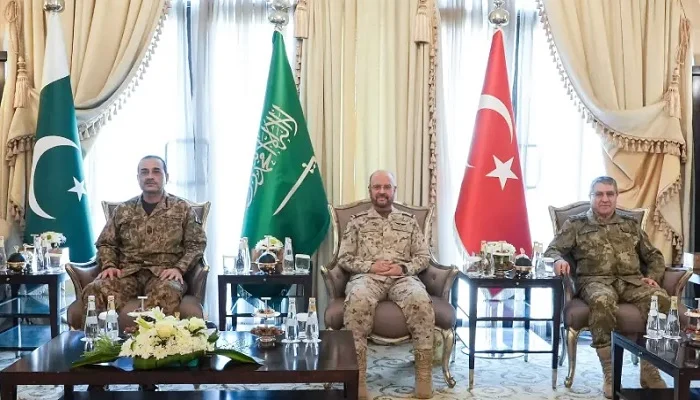
Top military officials from Saudi Arabia, Pakistan, and Turkiye have agreed to move quickly in putting the terms of the Makkah Joint Defence Agreement into practice, signaling a new phase of trilateral military coordination.
The commitment emerged from a high-level meeting held in Riyadh on Friday, bringing together the Chiefs of Defence Forces and Chiefs of General Staff of all three nations. According to Pakistan’s Inter-Services Public Relations (ISPR), the officials used the session to assess ongoing security threats facing Saudi Arabia and to chart a path forward for joint military action.
Condemnation of Attacks on Makkah and Praise for Saudi Forces
During the talks, the defence leaders firmly denounced any hostile acts directed at the holy city of Makkah, along with strikes on civilian and economic targets. They also commended the Saudi Armed Forces for their alertness and professional conduct in safeguarding the kingdom and its citizens.
Much of the discussion centered on practical steps to deepen military ties between the three countries. This included expanding intelligence-sharing arrangements, improving operational coordination, and merging elements of their defence capabilities to strengthen deterrence and build a more unified defensive posture.
Officials also pointed to the decades-long relationship and deep mutual confidence shared among the three nations, describing the Riyadh gathering as proof of how solid their defence ties have become. They renewed their pledge to stand by one another in matters of collective security and reaffirmed their shared resolve to protect Saudi Arabia’s sovereignty, security, and territorial integrity.
Background: How the Makkah Joint Defence Agreement Came Together
The Makkah Joint Defence Agreement traces back to August 7, 2026, when Pakistan, Saudi Arabia, and Turkiye formally signed the pact during the Makkah Al-Mukarramah Summit for Joint Defence. The core principle of the agreement is straightforward: an armed attack on any one signatory will be treated as an attack on all three.
Beyond its mutual defence clause, the agreement lays the groundwork for tighter military collaboration, joint training exercises, and coordinated defence planning. The three governments also agreed to set up dedicated political and military channels, bringing together their foreign ministers, defence ministers, and top military commanders on a regular basis.
Turkish Foreign Minister Hakan Fidan confirmed that the alliance would headquarter its secretariat in Riyadh, with Pakistan supplying the first secretary general. Pakistan has since named retired Lieutenant General Nauman Mahmood to that role, and the General Secretariat is now officially operating out of the Saudi capital.
Talk of Expanding the Alliance to Include Iran
Discussions around widening the alliance’s scope have also surfaced. Turkish Parliament Speaker Numan Kurtulmus suggested on Friday that the Makkah Joint Defence Agreement might eventually evolve into a wider security framework for Muslim-majority nations, noting that Iran could potentially be brought into the fold.
Kurtulmus clarified that Turkiye does not see the pact as targeting Iran in any way. Adding an international dimension to the conversation, Russian Foreign Minister Sergey Lavrov has separately voiced support for including Iran in a broader regional security structure, arguing that Tehran’s involvement could help stabilize the wider region.
As the alliance’s institutional framework takes shape in Riyadh, attention will likely turn to how quickly the pledged military cooperation translates into concrete joint operations, and whether further countries eventually join the pact.