


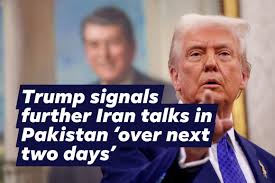
The second round of Iran talks may take place as early as Friday, according to US President Donald Trump, who described recent developments as a positive move toward renewed diplomatic engagement.
The announcement of the second round of Iran talks comes at a sensitive time, with Washington and Tehran maintaining a fragile ceasefire while also exchanging strong political statements. Trump said US forces have been instructed to continue enforcing a blockade on Iran but remain fully prepared for any situation that may arise.
He added that the ceasefire will remain in place until Iran presents workable proposals. According to him, the continuation of the truce depends directly on progress in diplomatic discussions, making the second round of Iran talks a key step in the ongoing process.
Trump also said the extension of the ceasefire is a constructive development that could open the door for more structured negotiations. While no official schedule has been confirmed, he indicated that the second round of Iran talks is expected to begin on Friday.
Earlier, Trump posted on his social media platform, Truth Social, claiming that a planned military strike on Iran was delayed after requests from Pakistan’s Prime Minister Shehbaz Sharif and Chief of Army Staff and Chief of Defence Forces Field Marshal Asim Munir. He said the delay was intended to give Iran a chance to present a unified proposal and move forward with dialogue.
He further stated that the US military will continue enforcing the blockade while staying on high alert across all operational fronts. Trump also claimed that internal divisions within Iran’s leadership are increasing, reflecting pressure from the current geopolitical situation.
Iran, however, rejected Trump’s remarks. A senior adviser to Iranian Parliament Speaker Mohammad Bagher Ghalibaf said the extension of the ceasefire holds no real meaning. He argued that continued pressure through blockade is similar to military action and should be met with a strong response.
The Iranian adviser also suggested that the US position may be an attempt to delay and gain strategic advantage. He called for Tehran to take independent and decisive action, saying the moment requires a firm national response.
He further warned that relying on prolonged negotiations could weaken Iran’s position, while stressing that the country should move forward with its own strategy.
The second round of Iran talks is now seen as a critical moment in the broader US-Iran standoff. While Washington signals openness to dialogue, Tehran continues to question US intentions, keeping the situation highly tense and unpredictable.