


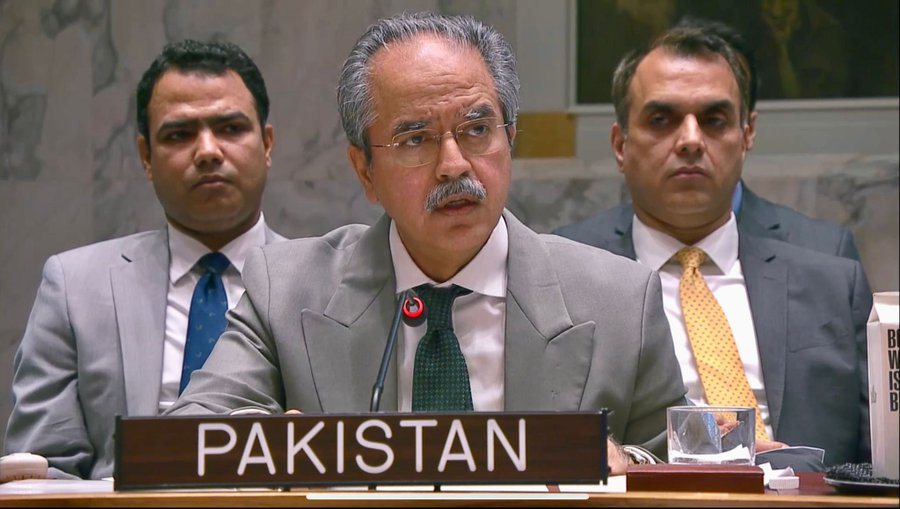
The Strait of Hormuz crisis is no longer just a regional concern, it has become a direct threat to global peace, economic stability, and the livelihoods of millions across developing nations. That was the clear message Pakistan delivered at the United Nations Security Council this week.
Pakistan’s permanent representative to the UN, Ambassador Asim Iftikhar Ahmad, addressed a high-level debate on maritime security, organized by Bahrain during its presidency of the 15-member Council. He warned that any disruption to routine sea traffic carries severe consequences not just for shipping lanes, but for the entire global economy.
“Any disruptions to the routine traffic at sea gravely impact international trade with negative repercussions for the global economy, and breed volatility that imperils international peace and security,” he said.
The ambassador pointed to the Strait of Hormuz crisis as a prime example of how a single chokepoint can trigger a chain reaction across food supplies, energy markets, and global supply chains. He stressed that if the situation continues, developing countries will bear the heaviest burden. Rising costs of oil, gas, fertilizers, and essential commodities will quickly spiral into inflation, shrinking economic growth, and balance of payment pressures for the most vulnerable nations.
Pakistan, he noted, is not a distant observer. As a coastal state in the Indian Ocean Region, sitting close to some of the world’s most critical maritime chokepoints, it depends heavily on sea-borne trade. The crisis hits close to home.
What sets Pakistan’s position apart is its active diplomatic role. Backed by China, Saudi Arabia, Türkiye, and Egypt, Pakistan has led efforts to ease tensions between the United States and Iran, pushing for dialogue and a peaceful resolution. Ambassador Asim Iftikhar reaffirmed that Pakistan’s commitment to diplomacy remains firm and unwavering.
Beyond diplomacy, Pakistan has taken concrete steps on the water. Earlier this year, it assumed command of Combined Task Force 150, which conducts maritime security operations outside the Arabian Gulf to protect commercial shipping. Last year, it led CTF-151, focused on suppressing piracy and keeping trade routes open. Pakistan has also launched its own Regional Maritime Security Patrols to maintain safety in surrounding seas.
The ambassador also called on the international community to uphold the legal framework established by the United Nations Convention on the Law of the Sea (UNCLOS), describing it as one of the most vital pillars of the global maritime order.
Pakistan, he said, will continue engaging with the Security Council and all like-minded nations to protect and strengthen global governance, “both in the gentle tides of peace and amity and amid the rising storms of conflict and conflagration.”
“This is a sacred trust that history has placed upon us, and we cannot afford to fail.”