


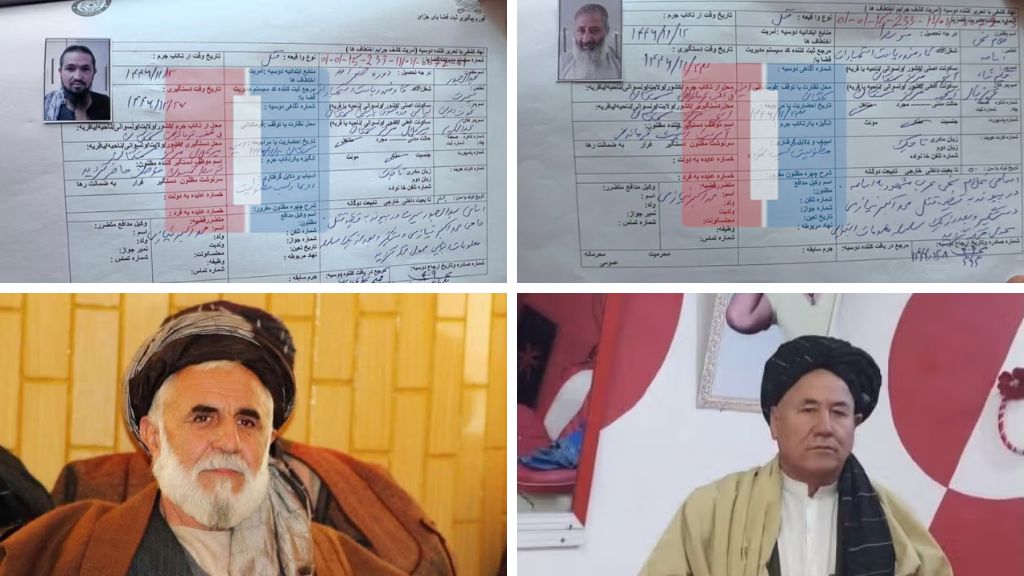
A collection of official documents and internal Taliban reports reveals direct involvement of Taliban members in extrajudicial killings across several Afghan provinces. These killings were not isolated events. Evidence shows a clear and repeated pattern of violence carried out on official orders.
Videos, internal reports, and documents obtained from sources inside Taliban institutions in Herat, Samangan, and Baghlan confirm that Taliban intelligence and security officials ordered these killings. The perpetrators used government-issued weapons and carried out the acts while on official duty.
At least five videos containing confessions by Taliban members involved in targeted killings were reviewed. Many victims were killed without any proper investigation. In several cases, accusations of espionage were based only on rumors or personal disputes.
Herat Case: Money Changer Killed in Front of His Family
One of the documented Taliban extrajudicial killings occurred in Herat. Ahmad Shah Noori, a money changer, was shot dead on December 3, 2025, while traveling with his family on the Herat–Gulran road.
Two armed men on a motorcycle stopped his car, forced him out, and shot him in front of his family.
Documents show that Gul Agha, head of a Taliban intelligence unit in Badghis province, ordered the killing. Two Taliban members, Aziz Nusrat and Najmuddin, carried out the operation using state-issued weapons.
In a video confession recorded 40 days later, Gul Agha admitted planning the killing months in advance. He said he provided a motorcycle and promised Aziz Nusrat one million Afghanis as payment.
Najmuddin, a Taliban soldier stationed at the Kamarkalagh checkpoint, also confessed. He said he shot Ahmad Shah Noori three to four times during official duty hours using his service weapon.
Samangan: Tribal Elder Abducted and Killed
Another case of Taliban extrajudicial killings involved Mohammad Akbar Niazi, a respected tribal elder from Samangan province. He was abducted on May 8, 2025, after receiving a phone call asking him to attend a meeting.
Two days later, his body was found in the mountains with multiple bullet wounds and signs of torture.
An official letter from the Taliban Interior Ministry confirmed that the killing was carried out using a pistol belonging to a Taliban member. Ballistic tests matched all bullets to a single Makarov pistol.
Following the incident, three Taliban members, including intelligence officers, were detained. However, authorities never publicly explained the outcome of the case.
Baghlan: Family Members Killed by Mistake
In Baghlan province, two family members, Hikmatullah and Gul Mohammad, were shot dead in August. Sources said the Taliban had ordered the killing of another individual, but the assigned attackers mistakenly killed the uncle and nephew.
Video confessions show Taliban commander Hamdullah admitting his role in killing Hikmatullah with permission from senior Taliban figures. Another Taliban member, Hanzala, confessed to killing Gul Mohammad.
Hanzala said he was told the victim was a “spy” and claimed he participated in the killing to gain religious merit. He admitted firing the fatal shots after receiving weapons from a Taliban commander.
Pardons, Blood Money, and Silence
Despite clear confessions and evidence, Taliban authorities released several perpetrators. Victims’ families were pressured to sign pardon letters in exchange for blood money.
In Baghlan, local media reported that the dispute was resolved through “peace and reconciliation.” The killer’s family paid 2.5 million Afghanis as compensation.
Taliban officials facilitated the settlement, replacing formal trials with jirgas and financial agreements. Families were reportedly warned not to speak to the media.
A Pattern of Impunity
These cases show that Taliban extrajudicial killings since August 2021 are part of a systematic pattern. Senior officials intervened to protect perpetrators. Judicial processes were bypassed. Accountability was replaced with secrecy and monetary settlements.
Human rights organizations say former Afghan security personnel, ethnic and religious minorities, journalists, civil society activists, and local leaders have been frequent targets.
The United Nations has repeatedly stated that the Taliban violated their own general amnesty decree. However, no independent and transparent investigations have been conducted.
With media restrictions, fear, and the absence of an independent judiciary, many killings remain undocumented. Rights groups warn that this ongoing impunity is deepening Afghanistan’s human rights crisis.