

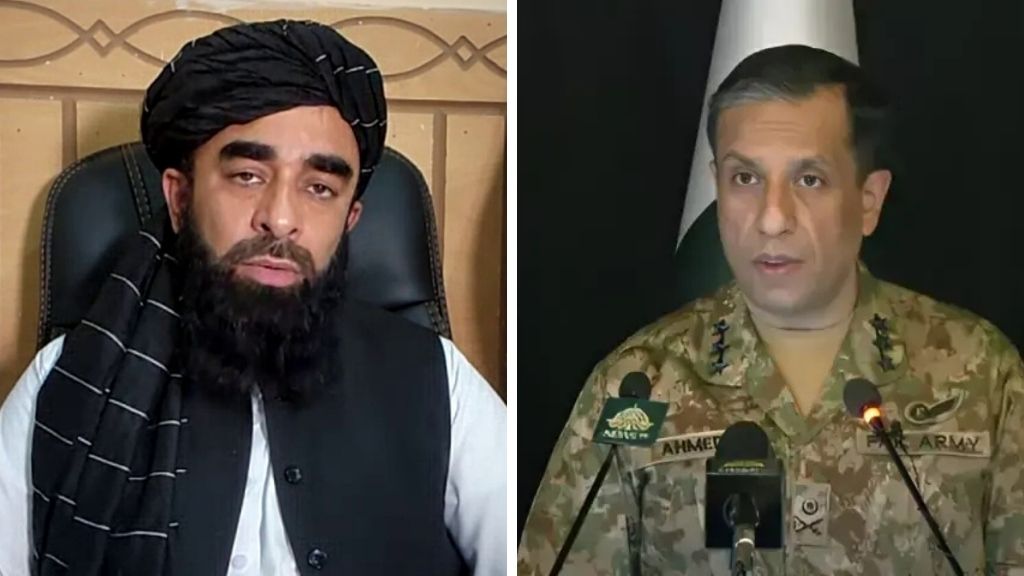
The recent exchange between the Afghan Taliban-led interim government and Pakistan’s military spokesman, Lieutenant General Ahmad Sharif Chaudhry, reveals a deeper vulnerability within the Taliban regime. In response to Chaudhry’s press conference on Tuesday, where he detailed over 5,400 terrorist incidents in Pakistan last year, the killing of 2,597 terrorists, and the involvement of Afghan nationals in major attacks, Taliban spokesman Zabihullah Mujahid issued a strongly worded rebuttal on X. Mujahid dismissed the statements as “contrary to facts” and “incompatible with the requirements of a responsible military position,” while asserting Afghanistan’s sovereignty and warning against interference in its internal affairs. However, this defensive posture underscores the Taliban’s underlying fears: their government lacks democratic legitimacy, excludes key Afghan groups, and struggles to maintain control over terrorism emanating from its soil, all of which invite further international isolation and criticism.
At the core of the Taliban’s unease is the glaring absence of international recognition for their regime. Since seizing power in August 2021, no country has formally recognized the Taliban as Afghanistan’s legitimate government. This stems from their forceful takeover without elections, their imposition of draconian policies rooted in a rigid interpretation of Sharia law, and their failure to form an inclusive administration. Mujahid’s emphasis on Afghanistan being a “sovereign and stable country” with “complete sovereignty over its entire territory” rings hollow when viewed against this backdrop.
The regime’s exclusion of ethnic minorities, women, and former opposition groups such as those from the Panjshir Valley resistance or Hazara communities has alienated broad swaths of the Afghan population. Without inclusive governance, the Taliban cannot claim to represent the “Afghan nation” they invoke in their statements. This lack of legitimacy makes them hypersensitive to external critiques, as any accusation like Pakistan’s claims of Afghanistan harboring terrorists could amplify calls for sanctions or diplomatic pressure from bodies like the United Nations. Moreover, Mujahid’s call for Pakistan to adopt “responsible behavior and serious statements” while considering the “delicacy of relations between the two countries” betrays a regime more concerned with self-preservation than addressing substantive issues.
Pakistan’s allegations are not baseless; Chaudhry cited specific incidents, including attacks on the Jaffar Express, FC Headquarters in Bannu, and Cadet College Wana, where Afghan citizens were involved. He further claimed that organizations like Al-Qaeda, ISIS, BLA, and others are being nurtured in Afghanistan, with around 2,500 foreign fighters recently arriving from Syria. These assertions align with broader reports from international observers, such as the UN Security Council, which have documented Afghanistan under Taliban rule becoming a safe haven for transnational terrorist groups. The Taliban’s inability or unwillingness to dismantle these networks contradicts their claims of stability and control. Instead of engaging constructively perhaps by proposing joint border security measures or investigations their response resorts to deflection and threats of unacceptability, suggesting a regime ill-equipped for diplomatic maturity. This reaction also highlights the Taliban’s paranoia about escalating global criticism.
As an unelected entity, they operate without the mandate of the people, relying on force rather than consensus. Their policies, including bans on women’s education and public participation, have drawn widespread condemnation from human rights organizations and Western governments, further eroding any potential for recognition. In the context of Pakistan’s statements, the Taliban likely fear that such public accusations could embolden other neighbors like Iran or Central Asian states to voice similar concerns about cross-border threats. This could lead to tightened borders, reduced aid, or even military escalations, all of which threaten the regime’s fragile hold on power. Mujahid’s appeal for “responsible” conduct from Pakistan is, in essence, a plea to avoid shining a spotlight on these weaknesses, as the Taliban know that their governance model marked by exclusion, repression, and tolerance of extremism does not withstand scrutiny.
The Taliban’s rebuttal is less a confident assertion of sovereignty and more a desperate attempt to shield an illegitimate regime from the consequences of its failures. By labeling Pakistani statements as “threatening” and unacceptable, they evade accountability for terrorism exported from their territory, while their exclusionary rule continues to undermine Afghanistan’s stability. This episode serves as a reminder that without democratic reforms, inclusivity, and genuine efforts to combat extremism, the Taliban government will remain isolated, vulnerable to criticism, and ultimately unsustainable in the eyes of the international community.