


US Iran Military Escalation entered a dangerous new phase on Monday as fresh missile strikes, air raids and strong political statements pushed the region closer to full-scale war. The crisis now spans Iran, Israel, Lebanon and several Gulf states, raising fears of a wider regional conflict.
Lebanon reported 31 deaths after Israeli airstrikes continued for a second day. At least 149 people suffered injuries. Lebanese authorities also ordered the arrest of those accused of launching rockets toward Israel. The violence intensified after Hezbollah fired missiles toward the Israeli city of Haifa, calling it retaliation for the reported killing of Iran’s Supreme Leader in earlier attacks.
Hezbollah confirmed it had targeted Israeli defense systems and warned that continued Israeli operations would bring further responses. Israeli forces said they intercepted incoming projectiles and carried out air raids on Hezbollah positions in Beirut.
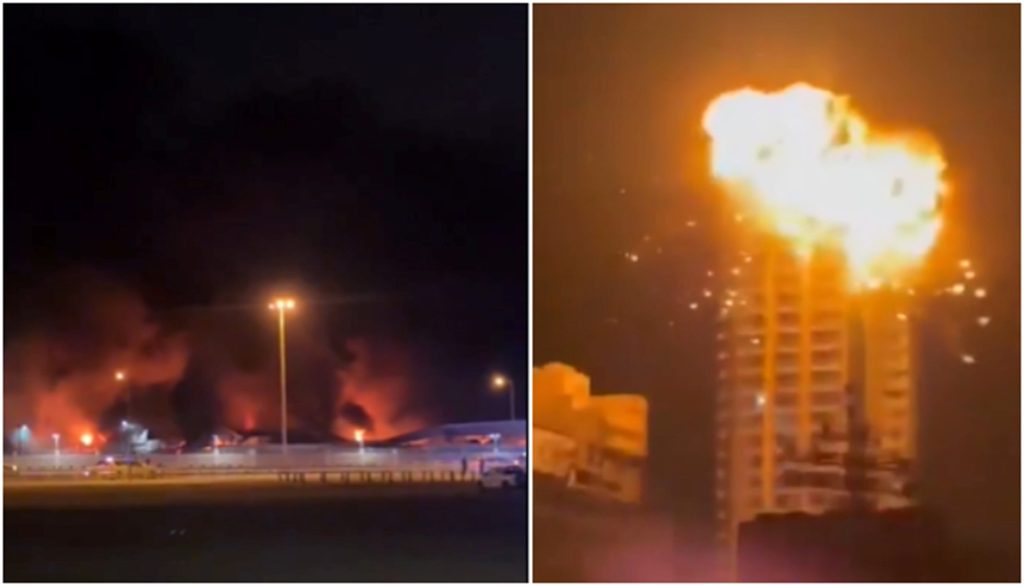
US Iran Military Escalation expanded beyond Israel and Lebanon. Iran launched fresh strikes on American-linked targets in Bahrain. Officials confirmed that one Asian civilian died in the attack. Thick smoke rose near the US Fifth Fleet headquarters in Manama, alarming residents across the city.
Iran also claimed it targeted US military bases in Kuwait and Bahrain. Iranian military sources said hundreds of American troops were killed, though independent confirmation remains unclear. Reports also mentioned missile strikes aimed at a US aircraft carrier in the region.
Meanwhile, a US F-15 fighter jet reportedly crashed in Kuwait. The pilot managed to eject safely and was taken to hospital with injuries. A video of the burning aircraft spread quickly on social media.
In Washington, President Donald Trump addressed the nation and defended ongoing operations. He said US forces struck Iranian Revolutionary Guard facilities, air defense systems and naval assets. Trump claimed that 48 key Iranian figures were killed and said Iran’s military command structure had collapsed. He warned that operations would continue until US objectives were achieved.
Trump also urged Iranian forces to surrender, saying those who lay down arms could receive exceptions. At the same time, he warned of severe consequences for those who continue fighting. His remarks further fueled US Iran Military Escalation, as Tehran rejected any possibility of negotiations.
Iran’s National Security leadership responded firmly. Officials said Iran would not hold talks with Washington. Military commanders declared that the country would defend itself with full force. They stressed that air defense units, drones and naval forces were operating in coordination.
The impact of US Iran Military Escalation has already reached global markets. Oil prices jumped 10 percent and climbed to 80 dollars per barrel. Analysts now warn that prices could touch 100 dollars if the crisis continues. Energy markets had already been under pressure earlier this year.
The widening battlefield now includes Israel, Lebanon, Bahrain, Kuwait and potentially the wider Gulf. With missile exchanges, naval threats and political ultimatums unfolding rapidly, US Iran Military Escalation has become the most serious security crisis in the Middle East in recent years. The coming days may determine whether diplomacy returns or the conflict expands even further.