


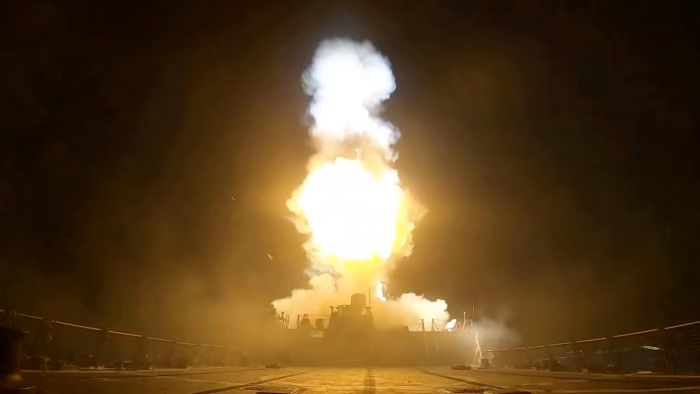
The United States launched a fresh round of strikes against Iran on Monday, marking the second consecutive day of military action as tensions over control of the Strait of Hormuz pushed the two nations closer to open war. Tehran responded by hitting American allies across the Gulf region, deepening a crisis that has already rattled global markets since fighting first erupted in late February.
The renewed hostilities mark a serious setback for a fragile interim agreement between Washington and Tehran that had been intended to wind down the conflict.
Centcom Confirms New Wave of Precision Strikes
US Central Command said on X that the latest offensive began at 2100 GMT on Sunday, coming less than a day after an earlier round in which 140 Iranian military sites were reportedly hit.
Centcom later confirmed it had carried out a fresh wave of offensive strikes, describing the targets as dozens of sites across multiple Iranian locations struck with precision munitions. The stated goal was to weaken Iran’s capacity to keep attacking commercial vessels moving through the Strait of Hormuz.
According to Centcom, the operation hit:
- Iranian air-defense systems
- Coastal radar installations
- Missile and drone launch capabilities
- Small naval boats
The command said it used fighter jets, warships, and — for the first time — one-way attack drones launched from both air and sea.
Centcom repeated its position that Iran does not control the Strait of Hormuz, insisting that US forces remain positioned to protect freedom of navigation despite what it called Iran’s ongoing “unwarranted aggression.”
Iranian Casualties and Damage Reported
Iranian state media said the American strikes hit wide areas of southern and western Iran, including Qeshm island, the port city of Bandar Abbas, and Khuzestan province near the Iraqi border.
An agricultural water pumping station in the southwestern city of Mahshahr was among the sites struck, according to an Iranian official cited by state media. The deputy governor of Khuzestan told IRNA that one person was killed and four others wounded in the attack.
IRGC Strikes US Bases Across Gulf Allies
In retaliation, Iran’s Revolutionary Guards Corps said it had struck American military assets in Jordan, Bahrain, Kuwait, and Oman. IRNA reported that targets included Prince Hassan Air Base in Jordan, a US drone command center in Bahrain, and Kuwait’s Ali Al Salem base.
The Guards claimed missile and drone strikes ignited fuel tanks and ammunition stores at the Jordanian base. A second phase reportedly targeted Bahrain’s Sheikh Isa base — not the Bahrain facility that hosts the US Fifth Fleet headquarters, though it has supported American military operations.
The IRGC also said it struck Kuwait’s Ahmad Al Jaber base, destroyed US facilities in Jafirah, Bahrain, and hit radar systems in Oman. Separately, Iranian forces said they shot down a US combat drone near Bandar Abbas on Monday, according to Mehr News. Washington had not responded to these claims at the time of reporting.
Iran’s Revolutionary Guards maintained that halting US military activity in the Strait of Hormuz was the only way to restore normal shipping traffic, warning that continued interference risked triggering larger incidents affecting global oil and gas markets.
Oil Markets React as Strait of Hormuz Standoff Deepens
Oil prices, which had dropped following the earlier ceasefire announcement, jumped more than 3.5 percent when futures trading opened Monday in Tokyo. The US benchmark WTI crude climbed above $74 a barrel.
Timeline of Escalation
The latest flare-up followed a chain of retaliatory strikes over the weekend:
- Iran reported strikes on two of its southern islands Sunday evening.
- Kuwait said its border posts and an offshore oil platform had been attacked.
- A commercial ship in the Strait of Hormuz was hit by what Iran called a warning shot, forcing its crew to abandon the burning vessel.
- Iran’s Revolutionary Guards then declared the strait “closed until further notice.”
- Centcom rejected the closure claim, saying the strait remained open and traffic was flowing.
Ship-tracking data from Kpler showed only six vessels passed through the strait on Sunday, the lowest figure in five weeks.
In earlier retaliation, the IRGC said it destroyed a command-and-control center and drone hangars in Jordan, hit a radar site in Kuwait, targeted refueling platforms in Oman, and struck a jet maintenance facility in Qatar.
Diplomatic Efforts to Contain the Crisis
Pakistan and other mediators have been working to salvage diplomacy after President Donald Trump declared this week that the ceasefire reached following the June 18 interim accord had collapsed.
Pakistan’s Deputy Prime Minister and Foreign Minister Ishaq Dar spoke by phone with Iranian Foreign Minister Abbas Araghchi on Sunday, urging de-escalation. Dar said dialogue remained the only realistic route to lasting peace in the region.
UN Secretary-General António Guterres also called for an immediate halt to the fighting, with his spokesperson saying the attacks must stop.
Iran’s foreign ministry said the US strikes had undone efforts toward regional peace and reignited insecurity around the Strait of Hormuz.
An adviser to Iran’s supreme leader underscored the strait’s strategic value on Sunday, describing control over it as more significant than possessing “dozens of atomic bombs”, a remark that captures how central the US strikes Iran Strait of Hormuz standoff has become to the wider conflict.