


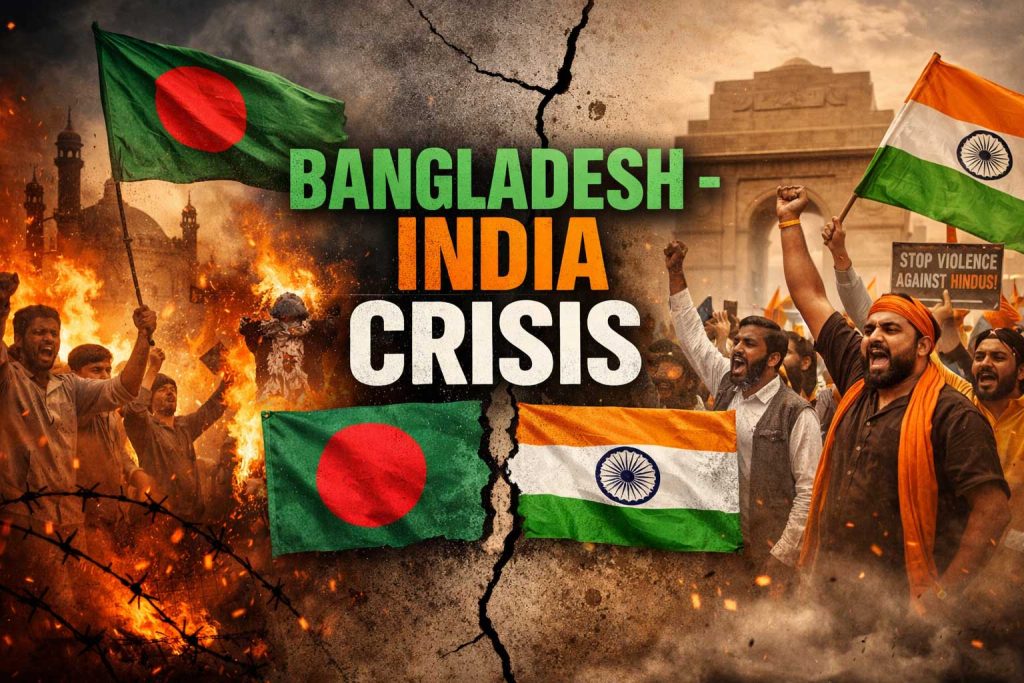
Relations between Bangladesh and India are witnessing what analysts describe as a historic and unprecedented crisis, marked by growing diplomatic tension, street violence, and rising public anger on both sides of the border. Recent violent incidents in Bangladesh, particularly the killing of a Hindu citizen during unrest, have further intensified an already fragile situation.
The latest flashpoint emerged after 27-year-old Hindu citizen Dipu Chandra was killed by a mob in Bangladesh following allegations of blasphemy. The incident triggered strong reactions from Hindu nationalist groups in India and sparked renewed accusations against Dhaka regarding the protection of minorities.
This killing took place amid violent protests in Bangladesh following the murder of student leader Usman Hadi in Dhaka. Supporters of the slain leader alleged that the main suspect was linked to the former ruling party, Awami League, and later fled to India—claims that fueled anti-India sentiment across Bangladesh. Bangladeshi police, however, have denied any evidence that the suspect crossed the border.
Escalating Diplomatic Fallout
In response to worsening security concerns, both countries have temporarily suspended visa services in several cities and summoned each other’s diplomats to lodge formal protests. Each side has accused the other of failing to provide adequate security to diplomatic missions.
Former Indian High Commissioner to Bangladesh Reeva Ganguly Das has expressed concern over the deteriorating situation, stating that continued instability makes it difficult to predict how relations may evolve.
Anti-India Sentiment in Bangladesh
Anti-India sentiment in Bangladesh is not new. Many Bangladeshis have long accused New Delhi of exerting excessive influence during the 15-year rule of former Prime Minister Sheikh Hasina. Public resentment intensified further after Hasina fled to India following her removal from office, while New Delhi has so far declined Dhaka’s requests for her extradition.
Following Usman Hadi’s killing, several Bangladeshi youth leaders reportedly issued open anti-India statements. Security forces were forced to block protesters from marching towards the Indian High Commission in Dhaka, while an Indian Assistant High Commission building in Chattogram was attacked by a mob.
In India, protests were also staged against Bangladesh. Dhaka strongly objected to demonstrations by Hindu groups outside the Bangladeshi mission in New Delhi, calling them unjustified and provocative.
Minority Safety and Rising Extremism
The brutal killing of another Hindu factory worker, Das, who was allegedly tied to a tree and set on fire by a mob, further inflamed tensions. Videos of the incident went viral on social media, intensifying outrage across the region.
Bangladesh’s interim government chief Muhammad Yunus condemned the violence, vowing that those responsible would face justice. Police confirmed the arrest of at least 12 suspects.
Human rights activists warn that the violence highlights growing risks faced by minorities and civil society groups in Bangladesh following the fall of Sheikh Hasina’s government. Reports indicate increasing attacks on Hindu communities, vandalism of shrines, disruptions of women’s sports events, and bans on cultural activities by extremist groups.
Regional Stability at Risk
Political analysts argue that hardline religious groups are exploiting anti-India narratives to justify violence against secular voices and minorities within Bangladesh. Swedish scholar Ashok Swain notes that political actors on both sides are using inflammatory rhetoric for domestic gains, while parts of the Indian media have amplified fears of widespread communal unrest.
From a Pakistan point of view, the crisis highlights the fragility of South Asian regional stability. Analysts agree that instability in Bangladesh poses serious strategic concerns for India, particularly in its northeastern regions, while also impacting broader regional peace.
The Way Forward
Bangladesh is scheduled to hold elections on February 12, but until an elected government takes charge, the interim administration faces mounting pressure to restore law and order. With the Awami League barred from contesting elections, the Bangladesh Nationalist Party (BNP) is expected to perform strongly, though religious parties such as Jamaat-e-Islami may emerge as significant challengers.
Observers caution that further exploitation of anti-India sentiment could deepen internal divisions and lead to more violence. Former Bangladeshi diplomat Humayun Kabir has stressed the importance of dialogue, stating that Bangladesh and India remain neighbors with shared strategic interests.
India has already signaled that it prefers engagement with a democratically elected government, which could open the door to diplomatic normalization. Until then, analysts urge restraint on both sides to prevent the crisis from spiraling further.