
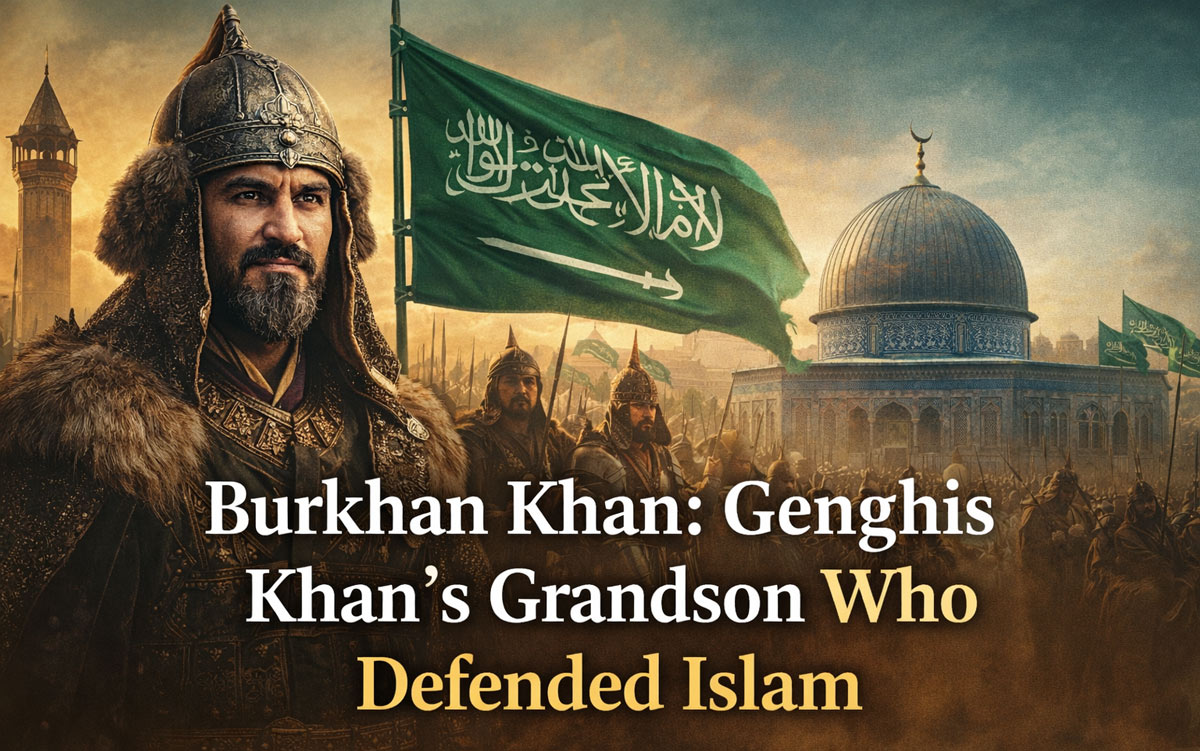
Burkhan Khan (1208–1266 CE), grandson of the legendary Mongol conqueror Genghis Khan, was more than just a Mongol commander. He was a visionary leader whose conversion to Islam, strategic brilliance, and moral courage helped reshape the course of history. From siding with Muslims against Hulagu Khan to protecting oppressed communities, his story is one of faith, wisdom, and heroism that continues to inspire.
Early Life and Spiritual Influences
Burkhan was born to Jochi Khan, Genghis Khan’s eldest son, and Sultan Khatoon, a woman known for her compassion and wisdom. Although Sultan Khatoon was not Muslim, she was deeply influenced by Islamic teachings and the guidance of prominent spiritual figures. Renowned Sufi saints like Ibn Arabi and Sheikh Saifuddin were widely respected, and their teachings impacted not only the general population but even Mongol rulers.
Sultan Khatoon instilled in Burkhan a dislike for unnecessary violence and a respect for justice. These early lessons shaped his ethical and humane approach to leadership. As Burkhan grew older, his curiosity about Islam deepened. Under the guidance of Sheikh Saifuddin, he embraced Islam, becoming one of the first Mongol rulers to convert, setting a precedent for others in his lineage.
Burkhan Khan and the Muslim World
The 13th century was a turbulent period for the Muslim world. Hulagu Khan, Burkhan’s relative, launched campaigns that devastated cities, including the destruction of Baghdad in 1258 CE, leaving the Abbasid Caliphate in ruins. The Muslim world was in shock and fear, unsure how to confront the Mongol threat.
In these challenging times, Burkhan Khan chose the path of justice and faith. He openly allied with Muslims and extended support to Sultan Baybars, the Mamluk Sultan of Egypt, sending letters of solidarity and pledging assistance against Mongol aggression. His stance showed that even Mongol princes could prioritize ethics and religion over blind allegiance to power.
The Historic Battle of Ain Jalut
The Battle of Ain Jalut stands as a turning point in both Islamic and Mongol history. Sultan Baybars led the Mamluk forces to halt the Mongol advance into Palestine, while Hulagu Khan advanced with a massive army seeking vengeance.
Burkhan Khan’s strategic brilliance proved decisive. He positioned his forces in areas where natural conditions could be leveraged. During the battle, frozen rivers and snow-laden terrain caused catastrophic losses for Hulagu’s army, with a large portion of troops drowning when ice broke under their weight. Hulagu was forced to retreat, and his son was killed in the conflict.
This marked the first major fracture within the Mongol empire, showing that internal divisions, combined with clever strategy and courage, could defeat seemingly invincible forces. Burkhan’s intervention not only saved Muslim lands but also inspired confidence across the Islamic world.
Leadership, Faith, and Legacy
Burkhan Khan’s story is as much about faith as it is about warfare. His leadership combined moral integrity, strategic acumen, and devotion to Islam, which left a lasting impact:
- Moral Leadership: He prioritized ethics over cruelty, guided by his mother’s upbringing and spiritual teachings.
- Military Strategy: He used environmental advantages and tactical planning to counter a superior army.
- Faith in Action: His conversion to Islam was not symbolic; it shaped his decisions and alliances.
- Inspiring Unity: His support for Muslims encouraged conversions among Mongol leaders and Tatars, fostering cultural and religious integration.
Even after his death in 1266 CE, Burkhan Khan’s influence endured. He proved that principled leadership and courage could alter the course of history, showing that faith and ethics are powerful tools in governance and warfare.
Burkhan Khan’s Lessons for Today
- Faith as a guide: Genuine belief can transform personal and political choices.
- Ethical leadership matters: Even in violent times, moral courage commands respect and inspires others.
- Intelligence over force: Strategic thinking can overcome brute strength.
- Legacy through action: One principled leader can influence entire generations.
Burkhan Khan’s life reminds us that history is shaped not just by power, but by wisdom, faith, and integrity. His story resonates as a timeless example for leaders, scholars, and ordinary people striving to make ethical choices in turbulent times.