
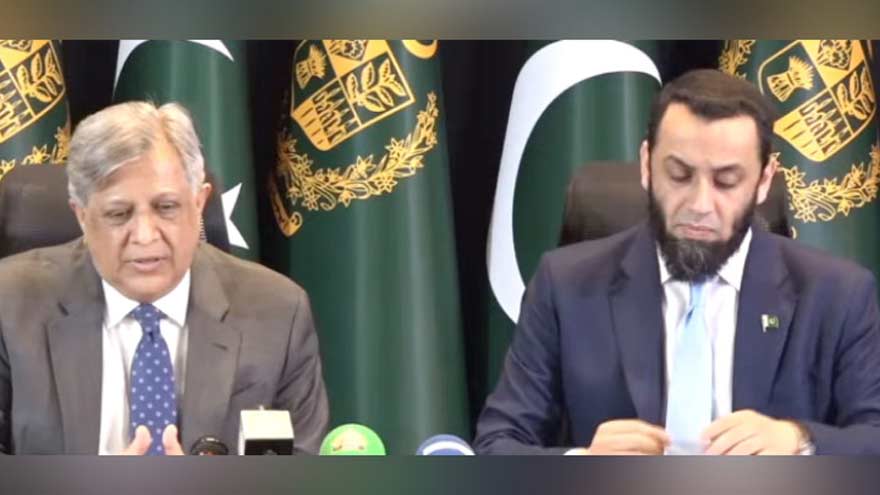
Information Minister Attaullah Tarar said on Tuesday that people in Khyber Pakhtunkhwa had “welcomed” the imposition of governor’s rule in KP, adding that he hopes it will help reverse the province’s worsening law and order situation.
He was speaking at a briefing for foreign media representatives, where Law Minister Azam Nazeer Tarar also appeared. Together, the two ministers laid out the federal government’s reasoning for the decision and its constitutional basis.
Federal Government Says Joint Strategy Was Rejected
According to the information minister, Islamabad had repeatedly approached the Pakistan Tehreek-e-Insaf (PTI) and the provincial government to agree on a shared counterterrorism strategy. He said those efforts did not produce coordinated action.
Tarar insisted the federal government had no political agenda. He said it expected conditions in the province to improve once governor’s rule and the emergency took effect.
He also addressed relations with Kabul. Islamabad, he said, was continuing dialogue and diplomatic engagement with Afghanistan, while urging the interim Afghan government to dismantle terrorist safe havens and take credible steps to stop Afghan soil from being used for attacks in Pakistan.
The provincial government, however, followed a different approach toward the interim Afghan administration, he said. “How can one country have two different policies on terrorism?” he asked. He added that the Constitution already contains provisions meant for situations like this.
Questions Over How KP Spent Its Funds
Describing the provincial administration as paralysed, Tarar said law and order had deteriorated sharply and terrorist activity had risen noticeably.
He pointed out that KP had received roughly Rs800 billion through the National Finance Commission (NFC) mechanism, and asked why that money had not been used to build stronger counterterrorism capacity.
According to the minister, the funds were not spent on setting up the Counter Terrorism Department (CTD), installing Safe City surveillance cameras, shaping an effective counter-extremism narrative, establishing forensic laboratories or buying modern equipment for the police.
Tarar also spoke about his recent trip to Kohat, the site of a terrorist attack. He said he met injured victims in hospital and visited the homes of those killed. Despite their suffering, he said, residents wanted terrorism to end, and the wounded had shown remarkable courage and resolve.
Questioning the province’s handling of security, he asked how a government charged with protecting lives and property could allegedly facilitate terrorist activity. He further alleged that a nexus existed between politics, terrorism and crime in KP.
No Timeframe Set for Emergency or Governor’s Rule
Law Minister Azam Nazeer Tarar said President Asif Ali Zardari had proclaimed the emergency in Khyber Pakhtunkhwa under Articles 232 and 234 of the Constitution. A growing number of terrorist incidents, he said, was a major factor behind the decision.
He said no specific timeframe could be given for how long the emergency or governor’s rule would last. The two measures run for different durations, he explained, and either can be extended if circumstances demand. He described the Constitution as the basic document governing the state and setting out procedures for handling such situations.
Terror Incidents in KP Rose Sharply, Law Minister Says
The law minister said Pakistan had faced terrorism for decades, with the effects spreading across the region after the Afghan war. He added that the nation had made heavy sacrifices in the fight against militancy and that counterterrorism operations were continuing.
Citing figures shared with the federal government by various institutions, he said 2,911 terrorist incidents were recorded in the province between 2021 and 2024. The number has since climbed to around 8,600, an increase of roughly 200 per cent. He named this rise as a key reason for the emergency.
On the military’s role, he said the Pakistan Army was helping with law enforcement and internal security, though defending the country’s borders remained its main duty. He added that the armed forces assist provincial governments in dealing with internal unrest when needed, and he praised the military and security agencies for their sacrifices.
Protecting innocent lives, he said, is a basic responsibility of the state.
Azam Nazeer Tarar called for stronger coordination among the relevant institutions so that counterterrorism efforts become more effective. Powers are divided between the federal and provincial governments under the Constitution, he noted, and both must act within their own constitutional and legal limits.