

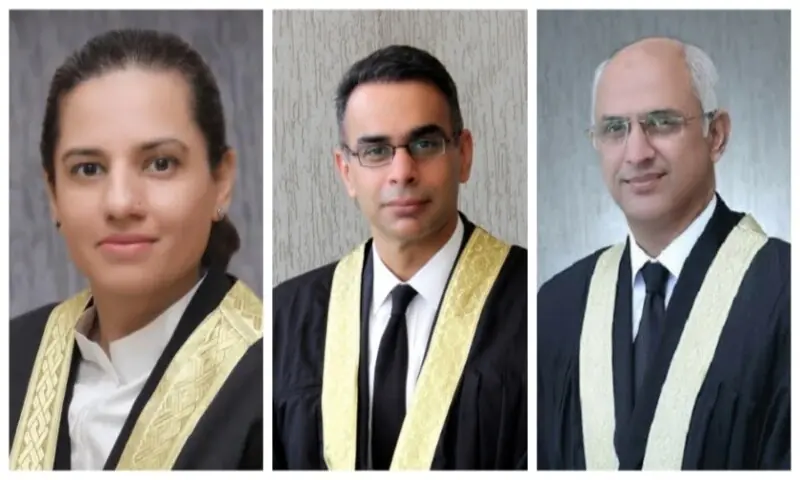
The IHC judges transfer has been officially approved by the Judicial Commission of Pakistan in a meeting chaired by Chief Justice Yahya Afridi, marking a significant development in the country’s judicial structure.
The decision involves the transfer of three judges from the Islamabad High Court to other high courts. Justice Mohsin Akhtar Kayani has been moved to the Lahore High Court, Justice Babar Sattar to the Peshawar High Court, and Justice Saman Rafat Imtiaz to the Sindh High Court. The approval came through a majority vote.
The IHC judges transfer was discussed in a meeting convened under Article 175A of the Constitution. According to the official statement, the meeting was held after members of the commission requested it, even though the chairman initially declined to call it.
The proposal for the IHC judges transfer was originally moved by IHC Chief Justice Sardar Sarfraz Dogar, who sought formal consideration of the matter. However, the issue soon became controversial within judicial circles.
Chief Justice Yahya Afridi had earlier raised concerns, stating that transferring judges without clear justification could be seen as a form of punishment. He also warned that such actions might affect judicial independence and weaken institutional stability. He further pointed out that the Constitution already provides a proper mechanism for dealing with judges under Article 209.
During the same meeting, proposals related to two other judges were withdrawn. The commission also decided that any vacancy created due to a judge’s transfer will be filled through transfer only and not through fresh appointments.
The IHC judges transfer has also triggered political reaction. Pakistan Tehreek-e-Insaf Chairman Barrister Gohar criticized the move, calling it harmful to judicial independence. He said that transferring judges without consent goes against constitutional principles.
He further argued that all high courts already have enough judges and questioned the need for such transfers. According to him, the decision could create divisions within the judiciary and affect its independence.
The issue continues to generate debate, with legal experts and political leaders closely watching its implications for Pakistan’s judicial system.