
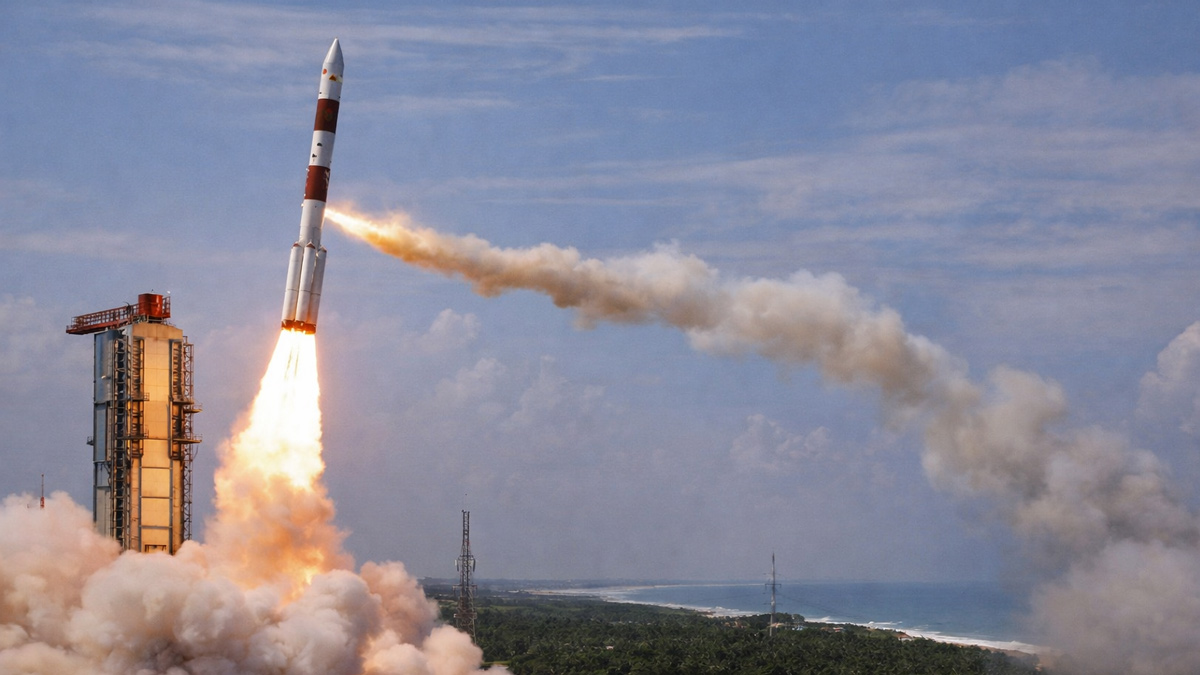
NEW DELHI: India has suffered another setback in its space programme after a rocket carrying an Earth observation satellite veered off course shortly after launch, marking the second failure of a key mission within eight months.
The Polar Satellite Launch Vehicle (PSLV), operated by the Indian Space Research Organization (ISRO), lifted off at 10:18am local time from the Satish Dhawan Space Centre on Sriharikota island.
The rocket was carrying the EOS-N1 Earth observation satellite along with 15 additional payloads, including scientific instruments and experiments developed by Indian and international startups and academic institutions.
ISRO’s mission control said the rocket performed normally during most of the flight. However, an unexpected anomaly later caused it to deviate from its intended trajectory.
In a brief statement, ISRO confirmed that the PSLV-C62 mission encountered a technical fault at the end of the PS3 stage. The space agency did not provide further details about the exact cause of the failure or where the rocket ultimately fell.
This is the second disappointment for the PSLV within eight months, a launch vehicle that has long been considered the backbone of India’s space programme. The rocket previously enjoyed a success rate of over 90 percent across nearly 60 missions.
The PSLV has played a central role in major Indian space missions, including Chandrayaan-1 and the Aditya-L1 solar observatory. It is also a key platform for India’s efforts to involve private industry in space manufacturing and satellite launches.
The latest failure is expected to prompt a detailed technical review by ISRO as it seeks to restore confidence in one of its most reliable launch systems.