
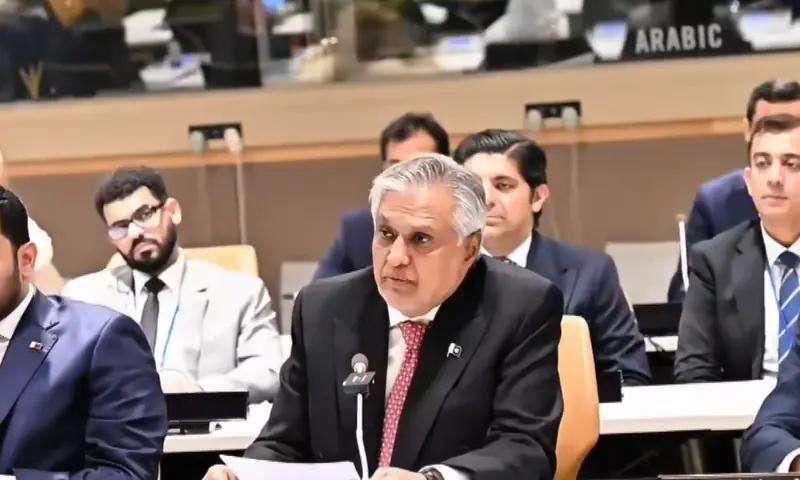
Deputy Prime Minister and Foreign Minister Senator Ishaq Dar called for tangible and verifiable measures to stop Afghan territory from being used to launch terrorist attacks against neighbouring states, with particular emphasis on Pakistan. He raised the issue while speaking at the Organisation of Islamic Cooperation’s Contact Group on Afghanistan, held on the sidelines of the UN General Assembly’s 81st session on Tuesday.
During his remarks, Dar voiced deep concern over the continued presence of militant networks operating from within Afghanistan. He referenced the heavy toll Pakistan has paid in its long fight against terrorism.
Kohat Attack Highlighted as Evidence of Regional Threat
Dar pointed to the recent terrorist attack in Kohat, Khyber Pakhtunkhwa, which killed several people and left many others wounded, describing it as clear proof of the danger terrorism from the region continues to pose. He argued that incidents like this make the case for immediate, concrete action against militant groups and the safe havens they use.
The deputy prime minister pressed the Afghan Taliban to fulfil Afghanistan’s international commitments, cut all support for terrorist organizations, and remove restrictions placed on women and girls that conflict with Islamic teachings and broader Muslim social norms. He also urged Afghan authorities to build a more politically inclusive system of governance and to support the return and reintegration of Afghan refugees.
Dar additionally called on the international community to provide sufficient funding to address Afghanistan’s humanitarian needs and back its economic recovery. He reaffirmed that Pakistan’s long-standing position remains support for a peaceful, stable, and prosperous Afghanistan that maintains good relations with its neighbours.
Dar is currently in New York as part of Prime Minister Shehbaz Sharif’s delegation attending the 81st UN General Assembly session. The prime minister landed in the city late Monday and is set to address the Assembly on September 25, joined by Dar, several federal ministers, and senior officials. The Pakistani delegation has also taken part in a number of sideline meetings covering bilateral relations, regional security, and other diplomatic issues.
Dar Raises Kashmir Dispute at OIC Forum
Separately, Dar addressed the OIC Contact Group on Jammu and Kashmir, expressing appreciation for the group’s continued backing of the Kashmiri people alongside support from the organization’s Independent Permanent Human Rights Commission. He noted that Kashmiris have spent close to eight decades waiting to exercise their right to self-determination under United Nations resolutions.
The deputy prime minister accused India of attempting to reshape the demographic makeup of Indian Illegally Occupied Jammu and Kashmir through steps taken after August 5, 2019. He said Kashmiri leaders and young people continue to face targeting under harsh legislation, while Indian authorities pursue tactics aimed at altering the region’s population balance.
Dar further claimed that India has worked to erode the Muslim cultural and religious identity of the region while suppressing journalists’ voices and denying international observers access to the valley. Referring to the Pakistan-India military confrontation in May 2025, he said the episode was a warning of how dangerous an unresolved Kashmir dispute could become.
He added that India made unfounded accusations against Pakistan last year without carrying out any formal investigation, while Pakistan responded in a measured and responsible manner strictly in self-defence.