
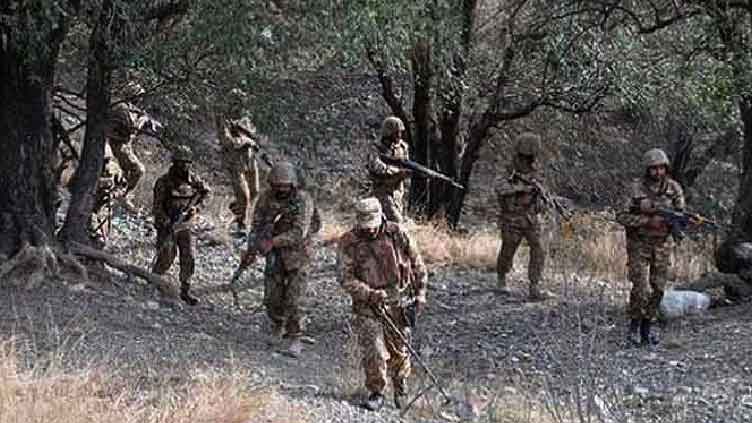
ISLAMABAD — Pakistani security forces eliminated 15 India-backed militants after intercepting an infiltration bid along the Pakistan-Afghanistan border facing North Waziristan district in Khyber Pakhtunkhwa, the military’s media wing confirmed on Thursday.
According to the Inter-Services Public Relations (ISPR), troops first spotted a group of Fitna al-Khawarij fighters attempting to slip into Pakistani territory during the night of August 31 into September 1. The North Waziristan terrorist attack unfolded after forces tracked the militants’ movement and responded with what ISPR described as a calculated, patient approach before launching their operation.
The confrontation stretched across 36 hours, ending with all 15 attackers neutralized. Troops then carried out a sanitisation sweep of the area, recovering a large cache of weapons and ammunition from the militants’ bodies.
Recovered Weapons Point to Cross-Border Terrorism Network
ISPR stated that the seized arms further revealed what it called the “nefarious designs” of the terrorists and the networks backing them, aimed at destabilizing peace within Pakistan.
The military’s statement renewed Islamabad’s long-standing accusation that the Afghan Taliban administration has repeatedly failed to stop its territory from being used to stage cross-border terrorism. ISPR also said Kabul’s interim government has not met its international commitments on border management, allowing militant movement to persist along the frontier.
Officials reaffirmed that security forces remain “resolute and unwavering” in guarding the country’s borders, adding that a follow-up sanitisation operation is still underway to clear any remaining India-sponsored Fitna al-Khawarij fighters from the region.
ISPR further stated that the counterterrorism campaign tied to the government’s Azm-e-Istehkam initiative will keep operating at full intensity to root out foreign-backed militancy across the country.
Rising Violence in KP and Balochistan
Terror-related violence has climbed sharply in Khyber Pakhtunkhwa and Balochistan since the Afghan Taliban’s return to power in 2021. A recent assessment by the Centre for Research and Security Studies (CRSS) found that these two provinces remained Pakistan’s primary conflict zones during the second quarter of 2026, with KP bearing the brunt of the bloodshed.
Per the CRSS findings, KP and Balochistan combined made up nearly 96% of all violence-linked deaths recorded nationwide during the quarter. KP alone accounted for over 61% of fatalities (475 deaths), while Balochistan reported 34% (265 deaths).
KP also logged the highest number of militant incidents at 151 cases, representing 57% of the national count, while Balochistan recorded 94 incidents, or roughly 35% — figures that highlight how militant activity remains heavily concentrated in these two provinces.