
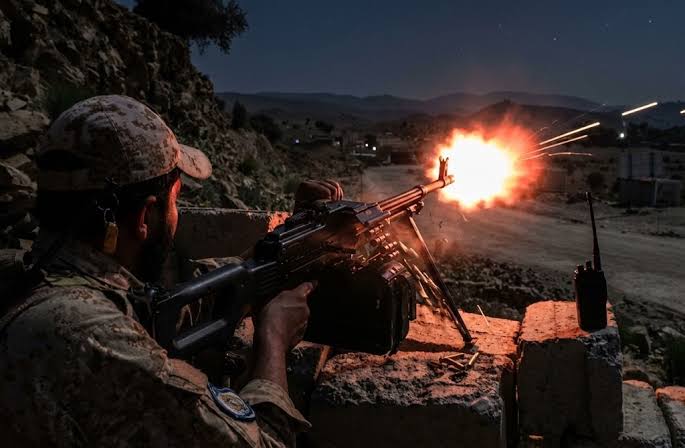
Pakistani security forces thwarted an attempted assault by Afghan Taliban fighters along the Pak-Afghan border on Thursday, striking back with a retaliatory operation that left several Taliban militants dead, according to security officials.
The clash unfolded in the Gulistan sector, a volatile stretch of the frontier that has seen repeated flare-ups in recent months. Officials familiar with the matter said troops reacted swiftly once the aggression began, catching the advancing fighters off guard and inflicting significant losses on the Afghan side.
As of Thursday, sporadic exchanges of gunfire were still being reported in the area. Security sources emphasized that personnel stationed along the border remain on high alert, monitoring the situation closely for any further incursions.
Drone Strikes Preceded the Ground Clash
The Gulistan sector confrontation followed closely on the heels of a separate military action: Pakistan carried out precision airstrikes and drone operations against ten sites inside Afghan territory. Information Minister Attaullah Tarar confirmed the strikes, describing them as a direct response to drone incursions the Taliban administration had attempted earlier in the week.
Security officials said Pakistani air defenses intercepted and destroyed eight drones that had crossed into national airspace from Afghanistan. Four of these were downed close to the Torkham crossing, while the other four were neutralized over rugged terrain near Kohat.
Speaking on the escalating tensions, Tarar reiterated that Islamabad has no interest in widening the conflict and remains open to dialogue and cooperative engagement to stabilize the region. At the same time, he cautioned that this openness should not be interpreted as passivity in the face of repeated provocations.
“Pakistan will defend its sovereignty, territorial integrity and the lives of its citizens with full resolve and will take all necessary measures to protect them,” Tarar said, warning that any additional hostile move by the Afghan Taliban would draw a “firm and resolute response.”
A Pattern of Rising Cross-Border Violence
The latest confrontation adds to a growing list of cross-border security incidents that have plagued Pakistan since the Taliban seized control of Afghanistan in 2021. The provinces of Khyber Pakhtunkhwa and Balochistan have borne the brunt of this uptick, with militant groups repeatedly exploiting the porous frontier.
Pakistani officials have long pressed Kabul to rein in armed factions operating from Afghan territory, arguing that these groups continue launching attacks against Pakistani troops and civilians largely unchecked. The Taliban government, for its part, has consistently denied these allegations, rejecting claims that it is failing to act against such elements.
In February 2026, Pakistan launched a dedicated counter-militancy campaign, Operation Ghazab lil-Haq, several months after both nations had agreed to a fragile ceasefire in October 2025 following an earlier wave of border skirmishes. Despite several rounds of diplomatic talks since then, the two neighbors have struggled to bridge their differences, with the presence of militant networks along the border remaining the central sticking point in Pakistan-Afghan relations.