
Islamabad:
President of the United Arab Emirates Sheikh Mohammed bin Zayed Al Nahyan arrived in Pakistan on a one-day official visit, during which he held high-level meetings with President, Prime Minister Shehbaz Sharif, and Chief of Defence Forces and Army Chief Field Marshal Asim Munir. The meetings focused on strengthening bilateral trade and expanding cooperation across multiple sectors.
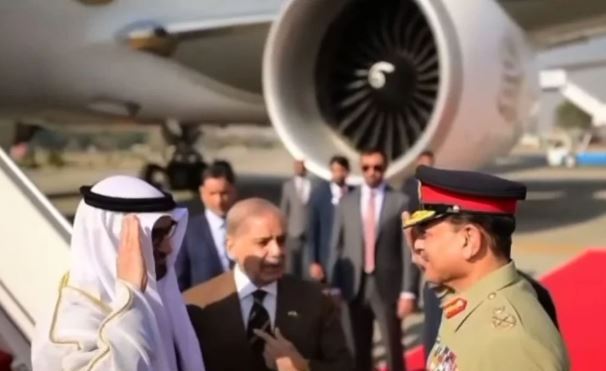
According to official sources, President Al Nahyan’s aircraft landed at Nur Khan Airbase, where he was accorded a warm reception. Pakistan Air Force JF-17 Thunder jet presented an aerial salute, while a contingent of the armed forces presented a guard of honour. A 21-gun salute was also fired in honour of the visiting dignitary.
Prime Minister Shehbaz Sharif and Field Marshal Asim Munir welcomed the UAE president along with members of the federal cabinet. Senior ministers, including Ishaq Dar, Khawaja Asif, Ahsan Iqbal, Attaullah Tarar, and others, were present on the occasion. The prime minister formally introduced the cabinet members to the UAE president. Sheikh Mohammed bin Zayed was accompanied by a high-level delegation.
During the visit, the UAE president held separate meetings with Pakistan’s leadership, during which regional developments, bilateral relations, and areas of mutual interest** were discussed.
In a detailed meeting between Prime Minister Shehbaz Sharif and President Sheikh Mohammed bin Zayed Al Nahyan, both leaders reviewed the long-standing fraternal ties between Pakistan and the UAE and explored ways to further deepen cooperation.
The two sides reviewed progress in existing areas of collaboration and discussed opportunities to enhance engagement in economic cooperation, investment, energy, infrastructure development, information technology, advanced technology, and people-to-people contacts. Both leaders emphasized the importance of strengthening trade relations and fostering sustainable economic partnerships.
The visit was described as a significant step toward further consolidating Pakistan-UAE relations and advancing shared goals of economic growth, regional stability, and long-term strategic cooperation.