
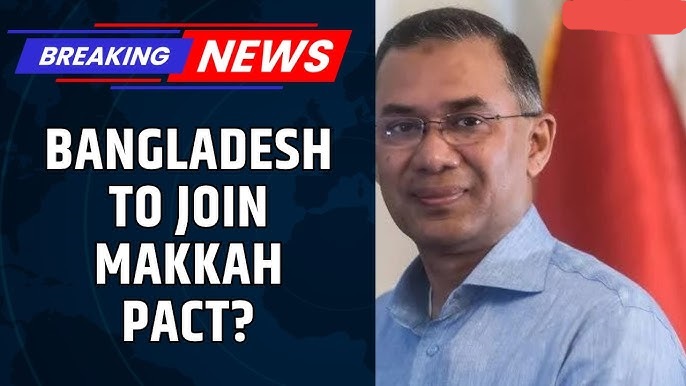
Bangladesh has expressed openness to joining the Makkah Joint Defence Agreement, a security pact linking Pakistan, Saudi Arabia, and Turkiye, according to local media reports.
Humaiun Kobir, the Prime Minister’s Foreign Affairs Adviser, said Dhaka takes a favourable view of joining any economic or defence structure involving the three nations, provided it aligns with Bangladesh’s own interests and the shifting patterns of global trade and economics.
Background on the Makkah Defence Pact
Pakistan, Saudi Arabia, and Turkiye formalised the Makkah Joint Defence Agreement on August 7, at a time of escalating tensions across the Middle East. Under its terms, an armed attack on any one of the three countries would be treated as an attack on all of them.
The timing of the pact follows growing instability in the region tied to the US-Israel conflict with Iran, which began on February 28 and has since drawn in multiple Gulf states while disrupting shipping through the Strait of Hormuz, a critical maritime corridor.
Speaking to the state-run Bangladesh Sangbad Sangstha (BSS), Kobir explained that Dhaka’s foreign policy follows a “Bangladesh First” approach, meaning decisions are shaped primarily around national interest. He added that Bangladesh continues to build its bilateral relationship with Pakistan through routine diplomatic channels, with particular emphasis on trade and people-to-people ties.
Who Signed the Agreement
The Makkah Joint Defence Agreement was formalised during the Makkah Al-Mukarramah Summit for Joint Defence, where Saudi Crown Prince and Prime Minister Mohammed bin Salman, Turkish President Recep Tayyip Erdogan, and Pakistani Prime Minister Shehbaz Sharif were all in attendance. The agreement outlines expanded defence coordination between the three countries and underscores their shared goal of promoting regional peace, security, and stability.
A day after the signing, Turkish Foreign Minister Hakan Fidan compared the pact’s structure to Nato’s Article 5 mutual defence clause, though he clarified that it was not aimed at Iran or any other specific nation. According to Fidan, the agreement functions as a broad commitment to safeguard the security of its three members, and he noted that President Erdogan hopes to see the alliance grow, citing Egypt as one possible future member.
Pakistan’s Position on Expanding the Pact
On August 9, Deputy Prime Minister and Foreign Minister Ishaq Dar said the Makkah agreement remains open to any country prepared to uphold its founding principles. He described the pact as defensive by design, stressing that it does not cancel or override any existing bilateral or multilateral commitments held by the three signatories.
Dar added that the framework welcomes nations willing to embrace cooperation, mutual respect, and peaceful resolution of disputes. He said the agreement fits within the core principles guiding Pakistan’s foreign policy and reaffirmed Islamabad’s intent to collaborate with regional partners in pursuit of peaceful conflict resolution and a more stable, prosperous future.