
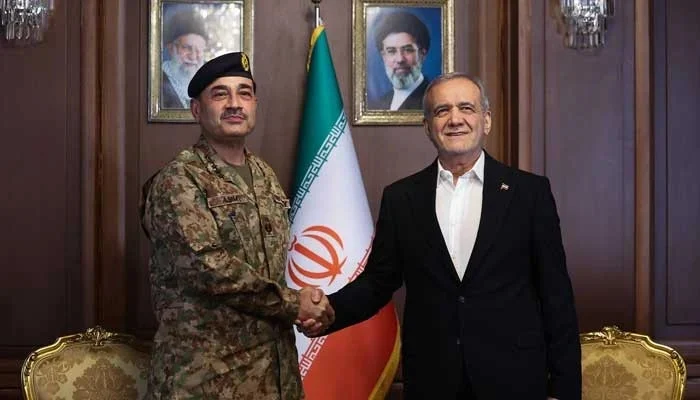
Chief of Defence Forces and Chief of Army Staff Field Marshal Asim Munir is scheduled to visit Tehran on Monday as tensions between Iran and the United States intensify over Washington’s planned economic measures.
The Asim Munir Iran visit comes as the US prepares what Treasury Secretary Scott Bessent has described as an unprecedented financial campaign against Tehran. Iran, meanwhile, has warned that continued economic pressure could lead it to stop oil exports through the Persian Gulf.
Iranian officials said the visit would focus on efforts to promote peace and regional security. A Pakistani government source said Field Marshal Asim Munir would also discuss recent developments, including the possibility of new US sanctions against Iran.
Asim Munir Iran Visit to Focus on Regional Security
Two Pakistani government sources confirmed the visit to Reuters. One source said Pakistan and Iran remain in direct communication.
A second government source said discussions would cover developments linked to the conflict, including US President Donald Trump’s warning of tougher economic sanctions against Tehran.
“He [CDF Munir] will discuss peace under Islamabad’s MoU, Trump’s warning and the situation after the Pakistan-Turkiye-Saudi Arab Agreement and Houthi issues with Iranian leaders,” the source said.
The visit follows Islamabad’s diplomatic efforts to reduce tensions between Washington and Tehran. The Shehbaz Sharif government brokered a two-week ceasefire between the two sides on April 8 after six weeks of fighting and has continued to pass messages between the two countries.
US Prepares New Iran Sanctions
The visit takes place as Washington prepares additional economic measures against Iran.
US Treasury Secretary Scott Bessent is scheduled to hold a press conference at 2pm EDT, or 1800 GMT, on Monday. He has indicated that the United States will announce more severe measures against Tehran.
In an opinion article published in the Financial Times on Sunday, Bessent described the planned campaign as the “single greatest financial offensive ever marshalled against an adversary.”
He also warned countries that continue economic and financial dealings with Iran despite US pressure. Bessent said nations that support what he described as “appeasement” should consider the consequences.
Iran Warns of Oil Export Shutdown
Tehran has responded strongly to the planned US sanctions on Iran, with Iranian officials warning that further economic pressure could trigger retaliation.
Mohsen Rezaei, secretary of Iran’s Supreme National Security Council, warned on Sunday that Iran could halt oil exports if what he called the economic war continued.
“If the economic war continues, not a single drop of oil will be exported, neither through the Strait of Hormuz nor from anywhere in the Persian Gulf,” Rezaei wrote in a social media post.
He also warned that Iran would consider any country’s participation in or support for the US economic campaign against the Iranian people as an act of war.
The threat has raised concerns over the potential impact on global energy supplies because the Strait of Hormuz is a major route for international oil shipments.
China Calls for Diplomacy
Bessent has previously urged China to cooperate with Washington, pointing to China’s reliance on Gulf oil supplies.
A spokesperson for China’s embassy in Washington said sanctions and pressure would not resolve the dispute and called for a diplomatic solution.
Iran’s economy was already facing significant difficulties before the latest conflict. International sanctions, high inflation, a weakening currency, energy shortages and structural economic problems had placed considerable pressure on the country.
The conflict has added further challenges, including damage to infrastructure, disrupted trade, reduced production and the financial burden of reconstruction.
Pakistan, Qatar and Turkiye Push for Diplomacy
With no official face-to-face talks currently taking place between the United States and Iran, countries including Pakistan, Qatar and Turkiye have attempted to facilitate diplomatic engagement.
The last direct US-Iran talks were held in June in Switzerland.
The wider conflict has caused thousands of deaths in Iran and Lebanon and displaced millions of people. The United States has reported 18 military personnel killed and more than 750 wounded.
Iran has retained missile and drone capabilities that could threaten Gulf states and shipping in the Strait of Hormuz. Disruptions in the strategic waterway have already placed pressure on global fuel markets.
The exact condition of Iran’s nuclear programme remains unclear, while Washington and Israel have sought to eliminate its nuclear capabilities.
The Asim Munir Iran visit therefore comes at a critical point, with Pakistan continuing its diplomatic efforts as tensions over sanctions, regional security and energy supplies remain high.