
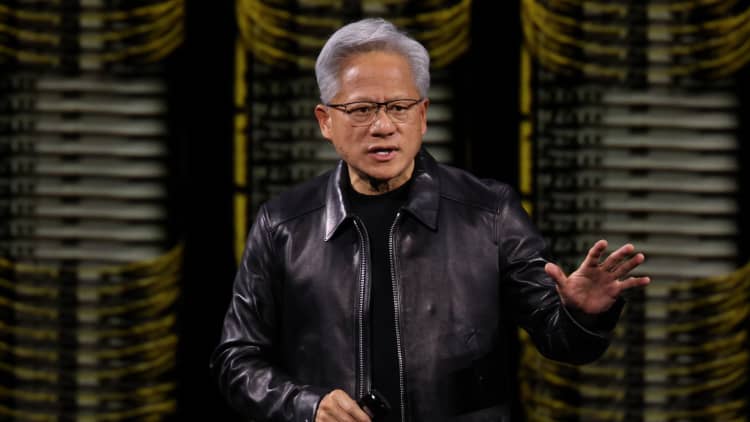
Jensen Huang steps down as Nvidia CEO, marking a major leadership change at the world’s most valuable chipmaker. His departure comes amid controversy over his reported personal relationships and concerns about the company’s future without its influential co-founder.
Nvidia announced on Thursday that Chief Financial Officer Colette Kress would serve as interim CEO while the company searches for a permanent successor. The company also appointed former Synopsys CEO and board member Harvey Jones as its first chairman.
Huang, who co-founded Nvidia, will also leave the company’s board. He holds an estimated 3.61 per cent stake in the chipmaker, making him its fourth-largest investor.
Nvidia shares fell more than 10 per cent in premarket trading following the announcement, putting pressure on the wider stock market.
The leadership change follows several reports about Huang’s alleged relationships with women linked to the technology industry. These include claims involving a Chinese businesswoman whom US authorities reportedly suspect of having links to Chinese intelligence.
The controversy intensified after reports alleged that Huang had a relationship with a senior Nvidia executive who reported directly to him.
According to a person familiar with the matter, Nvidia’s board met on Wednesday to discuss his possible removal. Earlier this month, independent directors had launched an investigation, with outside legal advisers, into whether Huang had been targeted by a foreign intelligence operation.
The company had expressed confidence in Huang when the investigation began.
His departure creates uncertainty for a company valued at around $4 trillion and raises questions about the future of the wider artificial intelligence industry.
Huang played a central role in turning Nvidia into the world’s leading supplier of AI chips. He also helped build an extensive business network by investing in cloud providers, technology suppliers and major AI research companies.
Michael Feldman, a portfolio manager at ClearBridge Investments, said Nvidia’s biggest challenge would be maintaining the coordination that Huang had established across its complex business operations.
He noted that the company’s technology roadmap remained largely visible for the coming years, but executing those plans without Huang could prove difficult.
The leadership transition also comes at a challenging time for the technology sector. Investors have become increasingly cautious about AI companies as rising debt and heavy spending raise questions about whether the huge investments in artificial intelligence will deliver expected returns.
Huang’s departure could also affect US policy on semiconductor exports to China. He had repeatedly argued for maintaining access to the Chinese market and maintained close ties with US President Donald Trump.
Trump praised Huang on Sunday, saying he had done an amazing job for the United States. Trump also said Huang had told him he was unaware that the Chinese businesswoman involved in the allegations was allegedly connected to espionage.
Huang’s rise to become an AI industry icon
Nvidia was once primarily known for producing graphics processing units (GPUs) used by computer gamers. However, the chips’ ability to handle large numbers of calculations simultaneously made them essential to the development of artificial intelligence.
As demand for AI technology surged, Nvidia became a central player in the global race to develop more powerful systems. Its success turned it into the world’s most valuable company and made Huang one of the technology industry’s most influential executives.
His popularity extended beyond business circles. Fans in Taiwan and South Korea regularly gathered to meet him, seeking autographs on books, posters and even their bodies.
However, recent reports have brought increased scrutiny of his personal and professional relationships.
One controversy involves Alice Huang, a former executive at Singapore-based cloud company Megaspeed. US authorities have reportedly concluded that she was a Chinese intelligence asset. Jensen Huang and Alice Huang are not related, although they have reportedly been photographed together in Taiwan, Singapore and California.
Megaspeed has also faced scrutiny from Washington over allegations that it helped China obtain advanced AI chips restricted under US export controls. The company was reportedly an official Nvidia cloud partner with priority access to its chips.
Beijing has denied that Alice Huang was a spy.
Another report by The New York Times alleged that Jensen Huang had a relationship with Kimberly Powell, Nvidia’s vice president of healthcare, who reported to him.
The allegations have added to the uncertainty surrounding Nvidia at a time when the company faces growing expectations from investors, intense competition and increasing geopolitical pressure.